The automotive industry is fundamentally changing, moving toward models that prioritise longevity and resource efficiency over disposal. When vehicles reach the end of their operational lives, they don't simply vanish; they become crucial sources of materials and components. This transition is built upon the principle of the circular economy, where waste is minimised and resources are kept in use for as long as possible. Participating in auctions through RAW2K's platform is a significant act of sustainability, providing the essential link between decommissioned vehicles and businesses focused on reuse.
The Role of Vehicle Auctions in the Circular Economy
Vehicle auctions serve as the primary gateway for diverting valuable assets away from the scrap heap and into reuse, refurbishing, or recycling programmes. These platforms ensure that a wide range of assets, from fully functional used cars to specialised salvage cars for sale, are redistributed efficiently. This process provides both economic advantages for buyers and significant environmental benefits for the planet. The high turnover of stock at auctions ensures continuous access to parts and materials that might otherwise be overlooked, demonstrating car part upcycling benefits at scale.
Salvage Vehicles as Sustainability Assets
Vehicles with a salvage title, classified as Category N or Category S, are often written off due to the high cost of repair relative to their market value, not because every component is unusable. Many of these vehicles contain thousands of pounds worth of perfectly good, original manufacturer parts. Engines, gearboxes, internal electronics, and undamaged body panels all retain significant utility and value. By acquiring these salvage vehicles, buyers are effectively investing in a pool of resources ready for immediate reintroduction into the supply chain, realising upcycling for a greener future.
Maximising Value from End-of-Life Vehicles
The process of deconstructing and reusing components from salvage cars represents one of the most significant car part upcycling benefits. Rather than investing enormous energy and resources into manufacturing new components from raw materials, a part is sourced, cleaned, and reused. This dramatically lowers the carbon footprint associated with automotive repair and restoration through wholesale vehicle auctions. Dealers specialising in parts acquisition often use various regional listings to maintain diverse and sustainable inventories.
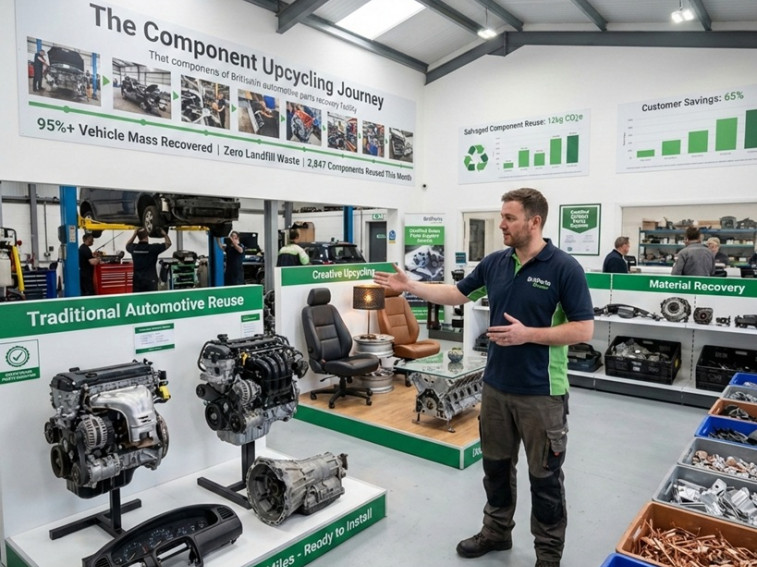
The materials recovered, including steel, aluminium, plastics, and glass, are also processed for recycling if they cannot be directly reused. This multilayered approach ensures that over 95% of a typical vehicle's mass is prevented from ending up in landfill sites. Buying from an auction is therefore a proactive choice that supports a more responsible and resource-efficient future for transport.
Practical Applications of Car Part Upcycling
Upcycling components extends the life of countless other vehicles, reducing demand for new manufacturing while providing affordable repair options. This practice isn't limited to just mechanical elements; it encompasses everything from interior textiles to complex electronic units. By focusing on repair and reuse, both dealers and private buyers can contribute to upcycling for a greener future within the UK automotive landscape.
Beyond the Scrap Heap: Creative Reuse
While the most common use for salvaged parts is vehicle repair, many components find new life in creative and industrial applications. Undamaged engines, for instance, are often sought after for specialised racing or kit car builds, where the original chassis damage is irrelevant. Even larger body sections and wheel assemblies are transformed into furniture, decorative art, or functional equipment in workshops. This creative reuse turns what many perceive as automotive waste into valuable commodities.
A classic scenario involves an experienced restoration specialist needing a rare, out-of-production part. Searching comprehensive listings, they find a decommissioned model with an intact rear axle, solving a supply crisis without turning to costly international manufacturing channels. This saves the time, cost, and environmental impact of bespoke production or lengthy overseas shipping, showcasing car part upcycling benefits in action.
Economic and Environmental Advantages
The economic case for upcycling for a greener future is compelling, especially when considering the sheer volume of metal, plastic, and fluids saved. Manufacturing a single new vehicle component consumes substantial energy, often relying on mining and refining processes with high environmental costs. When a salvage part is used, the only significant energy expenditure is for transportation, cleaning, and testing. The substantial car part upcycling benefits are clear: quality recycled components maintain the structural and operational integrity of the vehicle, often at a fraction of the cost of new parts.
The advantages of car part upcycling benefits span both environmental and economic dimensions. Environmentally, upcycling reduces energy consumption, lowers carbon emissions, conserves raw materials, and minimises landfill waste. Economically, it provides lower costs for repair shops and consumers, ensures access to rare or discontinued components, enables faster repair times due to ready availability, and creates higher profit margins for specialised recyclers. These dual benefits make upcycling an increasingly attractive option across the automotive industry.
A Structured Approach to Sustainable Sourcing
Making eco-conscious and successful purchases at auction requires discipline, much like successful bidding. You need to identify your specific parts requirements and then strategically source vehicles that offer the highest likelihood of providing those components in excellent condition through available cars. This structured approach applies equally to purchasing full vehicles for resale or dismantling.
Identifying High-Value Salvage Parts
When reviewing listings, look beyond the obvious damage and focus on the integrity of the high-value, complex components. For a Category S vehicle, carefully check the images for signs of impact transfer to the engine block or gearbox housing, especially if the primary damage is front-end. Similarly, on specialist listings including bike listings, look for pristine fuel tanks, undamaged forks, or low-mileage engine units that are easily detached.
If you're looking to find a reliable drivetrain for a restoration project, you might find a Category N car with extensive body damage but a documented, low-mileage engine. This is a highly strategic purchase because the cost of repairing the body outweighs the cost of pulling the desirable engine for reuse. Always verify the mileage and service history provided, as this directly affects the component's residual life and value.
Making an Informed, Eco-Conscious Purchase
Commitment to sustainability means supporting the regulated dismantling process. When you purchase a vehicle, you ensure that it enters a supply chain where its components and materials are responsibly managed. Reputable auctions partner with licensed Authorised Treatment Facilities (ATFs) to handle end-of-life vehicles, ensuring proper fluid drainage and material separation through comprehensive regional coverage.
Before you make a purchase, calculate not only the cost of repair but also the value of the components you plan to salvage or recycle. This ensures you're not just chasing a low price but maximising the resource recovery potential of the vehicle. By choosing to buy used vehicles or purchase salvage for parts, you directly participate in reducing the environmental impact of the automotive sector. This is a smart choice for your wallet and a crucial contribution to a cleaner, more resource-efficient future.
Start bidding today to source sustainable components and contribute to upcycling for a greener future. Browse current vehicle auctions to begin your journey toward responsible automotive resource management.