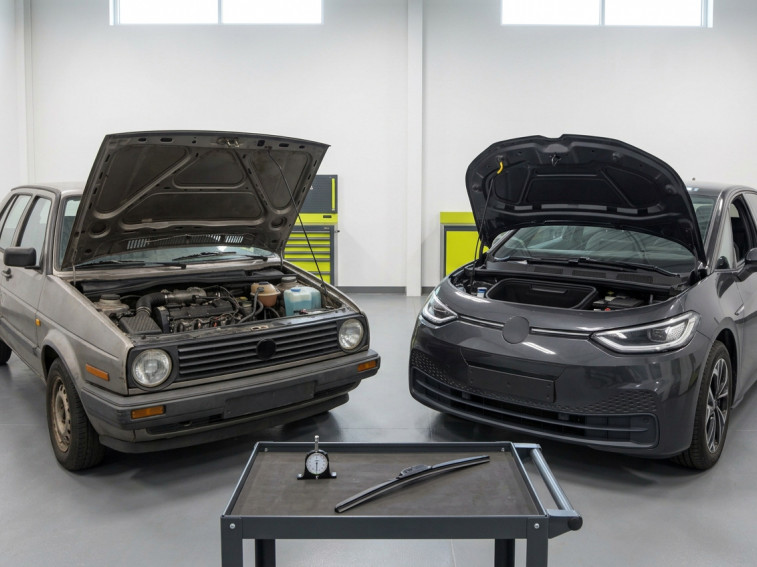
Moving from a petrol car to a used electric vehicle removes some familiar workshop jobs: there is no petrol-engine oil change, spark-plug replacement or exhaust repair. Tyres, brakes and suspension remain part of ownership. The useful comparison is not simply how often each car visits a garage, but what work the particular car needs and what its records show has already been done.
For your first used EV, start with the manufacturer's schedule for the exact model and year. Read it alongside the service history and present condition. That separates three different commitments: regular upkeep, maintenance already due and repairs to an identified fault. A shorter service schedule can reduce routine work without making a neglected or damaged example inexpensive to put right.
The Fundamental Shift Under the Bonnet
Open the bonnet of a petrol car, and you will find an engine with its associated lubrication, ignition, fuel and exhaust systems. A battery-electric car has no petrol engine, so engine oil changes, spark plugs and exhaust repairs disappear from its maintenance schedule. That distinction applies to fully electric vehicles, not hybrids that retain a combustion engine.
An electric motor replaces the petrol engine as the source of driving power. The US Department of Energy's maintenance comparison explains that all-electric vehicles generally need less maintenance because they have fewer moving parts, fewer fluids requiring regular attention and reduced brake wear through energy recovery. That is a comparison of maintenance demands, not a promise about the repair bill for every used car.
Petrol Maintenance Tasks You Can Forget
On a fully electric car, the following petrol-engine jobs disappear. This does not mean every remaining component is sealed for life; any separate fluid or inspection requirements still come from the vehicle's own schedule:
-
Oil changes: There is no petrol-engine oil or engine oil filter to change. Follow any separate fluid requirements for the components that transmit the motor's power to the wheels.
-
Timing belt replacements: The petrol engine's timing-belt replacement is no longer a scheduled job on a fully electric car.
-
Spark plug replacements: No combustion means no spark plugs to foul or replace.
-
Exhaust system repairs: There is no exhaust manifold, catalytic converter, or silencer to rust through.
-
Fuel filter changes: Without a petrol fuel system, the associated petrol fuel-filter change disappears.
Compare the actual service schedules rather than assigning a fixed annual saving to every EV. Ask which work is due now, what the previous owner completed and whether invoices match the vehicle's mileage. Removing engine-related jobs does not cancel overdue tyres, brakes or other maintenance.
Familiar Maintenance Territory
Tyres, windscreen wipers, washer fluid and wheel alignment still need attention. Cabin filters remain too: they filter air entering the passenger compartment, rather than air feeding a petrol engine. As a US example, maintenance for the Tesla Model 3 includes cabin-filter replacement every two years and a brake-fluid health check every four years with replacement if necessary. Heavy brake use, especially in hot and humid conditions, may require more frequent brake-fluid checks and replacements. Use the schedule for your own model and market to establish when these jobs are due.
Suspension still has joints that allow controlled movement and shock absorbers that damp bouncing. Those physical parts need assessment for wear just as they do on a petrol car. Judge the tyres and suspension by their actual condition rather than assuming an electric car must wear them out faster. For tyres, compare the fitted specification and condition with the vehicle's requirements; an old invoice for replacement tyres does not establish how much useful tread remains today.
EV-Specific Maintenance Priorities
The unfamiliar part of used EV maintenance is understanding what the electrical equipment does, not learning a completely new version of every car-care task. Start with the large battery that supplies driving energy, then distinguish its condition from the care needed by the brakes and any battery-cooling system. Those questions lead to different maintenance decisions.
Battery Wear Is Different From a Battery Fault
The traction battery is the large battery pack that stores energy for driving the car. Like other batteries, it wears over time. Remaining capacity describes how much energy it can still store, whereas an identified fault describes something that is not working correctly. A capacity result is therefore not automatically a diagnosis requiring replacement. Consider whether the remaining capacity meets your journeys, then separately establish any reported fault and the work proposed to address it.
Request any available battery-health report and ask what its figure measures, when it was obtained and which vehicle it covers. Do not read a dashboard range estimate as though it were a measured capacity result. The Department of Energy's battery guidance advises checking battery life and warranties with the dealer. For the car you are considering, establish the applicable warranty terms and whether a proposed repair is covered; do not assume a missing report means that a whole replacement battery is due.
Energy Recovery Does Not Replace Normal Brake Care
Regenerative braking recovers some of the car's movement energy as electricity while it slows down. The motor participates in that recovery, reducing the work demanded of the normal friction brakes: the brakes that slow the wheels by pressing pads against discs. The Department of Energy explains that this reduces brake wear. It does not give pads or discs a guaranteed lifespan, so their condition still belongs in the maintenance assessment.
Brake calipers are the mechanisms that press the pads against the discs. They still need appropriate care even when energy recovery reduces pad wear. For the US Tesla Model 3, caliper maintenance includes cleaning and lubricating the calipers every year or 12,500 miles when the car is used in an area where roads are salted during winter.
Cooling System Maintenance
Battery cooling keeps the pack within its intended operating temperatures. Some EV battery systems use liquid coolant for this, and those systems may need regular checks. Identify the arrangement on the actual model before looking for a coolant-change interval. A petrol car's engine-coolant routine cannot simply be transferred to an EV, nor should you assume that every used EV has a liquid-cooled battery.
Use the owner's manual to distinguish a scheduled coolant check from a cooling warning or suspected leak that needs investigation. A check and a replacement are different jobs: the record should say which was done. Do not choose or mix fluids by colour alone, or open a battery-coolant reservoir as an exploratory check. For the Tesla Model 3, damage caused by opening that reservoir is excluded from warranty. Follow the instructions for the actual car rather than treating coolant as an interchangeable top-up.
Record Outstanding Software Work
Ask whether any maintenance-related software work remains outstanding and whether it needs a workshop appointment. Keep it with the other due work. An update record answers a different question from a brake inspection or battery-capacity assessment; it should not be used as evidence that those physical checks have been completed.
The Cost Reality of EV Maintenance
For petrol vs electric servicing, compare the work each actual car needs over the same ownership period. Routine upkeep covers the scheduled checks and consumables. An existing charging fault or damaged component belongs in a separate repair estimate, not an inflated annual service figure. An unresolved symptom is not yet a priced repair. When comparing vehicles in our car auctions, carry those distinctions into the comparison: fewer engine-service items do not cancel a known defect, but neither should an unconfirmed problem become an invented replacement bill.
DIY Maintenance Opportunities and Limits
Owner care can still include familiar tasks such as replacing wiper blades or a cabin filter where the manufacturer's instructions permit it. Read the procedure for the exact model before starting; accessibility and precautions are not identical across cars. A straightforward consumable replacement is a different task from working underneath the vehicle or investigating its electrical equipment. Petrol-car experience is useful background, not a substitute for the EV's instructions.
High-voltage means the powerful electrical system associated with the driving battery and motor; contact with live parts can be fatal. Do not open the battery pack or undertake work on that system as routine DIY maintenance. HSE's EV guidance explains that components can retain dangerous voltage even with the car switched off, and that training, technical information and competence must match the task. Leave that work to appropriately competent professionals; owning electrical tools does not establish the ability to use them safely on an EV.
MOT Differences for Electric Vehicles
In Great Britain, a battery-electric car has no petrol exhaust to test, but an MOT is still separate from servicing. DVSA's inspection procedure requires testing without dismantling the vehicle. Its battery inspection rules limit assessment of the traction battery to a visual check where the tester can reach it; the pack is usually out of reach. An MOT pass therefore does not tell you how much energy that battery can still store.
Separate Auction Condition From Scheduled Upkeep
When reviewing our vehicle auctions, compare each lot's reported condition with the maintenance information available. A statement that a vehicle starts or drives describes that reported status; it does not itemise completed servicing. Equally, a service invoice does not explain a charging problem reported later. Keep those pieces of information separate so that a reassuring detail about one part of the car does not answer an unrelated question.
A listing that reports charging trouble or damage to a battery housing raises a repair question, not an extra routine service item. Record the reported issue in its own words rather than deciding from photographs which component needs replacing. If it cannot be resolved before purchase, recognise that the repair requirement remains unknown. This avoids two opposite mistakes: treating a fault as harmless because servicing is simple, or assuming that every battery-related concern requires a complete new pack.
The Smaller Auxiliary Battery Still Matters
The auxiliary battery is separate from the large traction battery: it serves the car's lower-voltage electrical equipment rather than storing the main supply of driving energy. Do not assume every model uses the same battery type or replacement schedule. On the Tesla Model 3, for example, a low-voltage lead-acid battery is a consumable part only where applicable. If an invoice says only 'battery replaced', establish which battery it means before treating it as evidence of work on the driving pack.
Confirm Support for the Exact Model
Before choosing a model, establish where you can obtain its scheduled maintenance and the parts actually needed. If a component has already been identified for replacement, ask whether the price includes any electronic setup required after fitting. That setup means configuring the replacement to work with the vehicle, not another routine fluid change. Resolve parts availability and the workshop route together here, rather than assuming that a familiar petrol-car badge guarantees support for every electric model.
Match Completed Work to What Is Due
Read the schedule and invoices side by side, matching each relevant task to its completion date and mileage. For example, a cabin-filter replacement does not establish that a brake-fluid health check happened at the same visit. Likewise, 'brakes checked' does not necessarily mean pads were replaced or calipers cleaned. Where the task description is unclear, seek that detail rather than counting the whole service schedule as complete because a general service entry exists.
Decide Whether This EV Fits Your Maintenance Needs
The maintenance difference is a shorter engine-related workload, not the disappearance of car care. A used EV retains tyres, suspension and brakes, alongside its own battery and cooling requirements. Compare that remaining schedule with the petrol car's engine servicing, keeping fault repairs separate.
Identify the next actual job: a scheduled brake-fluid check, replacement of a worn tyre or investigation of a reported charging problem. Establish when it is needed and who can undertake it, so the next maintenance commitment is concrete.
If an unresolved battery or electrical fault could make the car unsuitable or unaffordable, pause the purchase decision until its implications are established.