Plenty of traditional vehicle buyers completely ignore off-road machinery when browsing online catalogues, mistakenly assuming that All-Terrain Vehicles (ATVs) are either recreational toys or entirely thrashed agricultural cast-offs. This represents a massive oversight and a highly lucrative missed opportunity. Smart, mechanically inclined buyers regularly acquire highly serviceable ATVs for a mere fraction of their retail dealer value. They execute relatively straightforward mechanical repairs or minor cosmetic replacements, subsequently flipping the machines for excellent profit margins or putting them directly to work on private land.
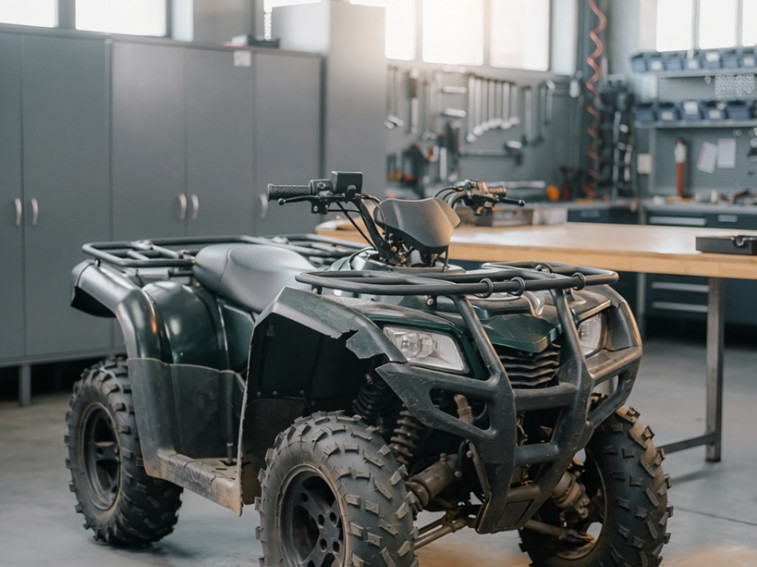
Quad bikes and ATVs consistently arrive at secure compounds for a multitude of logistical and financial reasons. A quad bike salvage auction processes thousands of these specific machines annually, including agricultural insurance write-offs, commercial finance repossessions, and municipal fleet clearances. Unlike modern passenger cars featuring complex unibody construction and sensitive crumple zones, ATVs are fundamentally rugged machines. They often sustain damage that appears completely catastrophic on an insurance assessor's clipboard but is actually highly manageable in a private workshop. A heavily cracked plastic fender or a snapped utility rack might mathematically write off an ATV on paper due to exorbitant main-dealer parts pricing, yet the core engine and drivetrain remain absolutely flawless.
Understanding Salvage Categories for Off-Road Vehicles
Many buyers operate under the false assumption that official insurance write-off categories apply exclusively to road-legal passenger cars. They do not. Quad bikes that have been processed through formal insurance claims are rigorously categorised using the exact same UK salvage framework. Thoroughly understanding these specific designations is the absolute foundation of identifying viable off-road value.
Category N signifies that the ATV has sustained purely non-structural damage. In the context of a quad bike, this typically involves cosmetic scrapes, shattered plastic bodywork, bent handlebars, or smashed headlights. The core tubular frame and the engine mounting points remain completely uncompromised. These machines frequently represent the absolute best financial investments because the required repair costs are typically restricted to simple bolt-on replacement components.
Category S indicates structural damage. For an ATV, this explicitly means the main frame, the subframe, or the swingarm has been compromised. Unlike modern passenger cars, the vast majority of quad frames are constructed from basic tubular steel. While this damage can sometimes be repaired by highly competent fabricators, it introduces significant risk regarding wheel alignment and drivetrain stress. Finally, Category A and Category B represent severe destruction, with Category B machines legally restricted from ever returning to use, making them strictly available only to licensed Authorised Treatment Facilities for parts reclamation.
Why Quad Bikes End Up at Auction
Thoroughly understanding the exact backstory of off-road machinery helps buyers accurately assess the associated mechanical risks. ATVs arrive at a quad bike salvage auction through several distinct operational pipelines. Insurance write-offs are exceptionally common within the agricultural sector following low-speed rollovers. A farm worker might clip a gate post, resulting in cracked plastics and a bent steering stem. Because the machine is a commercial asset, the insurance company simply writes it off rather than enduring lengthy dealer repair times that disrupt farm operations.
Finance repossessions provide another highly reliable pipeline. When commercial landscaping businesses or outdoor activity centres face administration, their entire fleet of heavy-duty ATVs is seized by bailiffs and sent directly to liquidation auctions. Because these machines were essential commercial tools, they are frequently maintained in excellent mechanical order prior to the business failure. However, adhering strictly to the "buyer beware" nature of digital platforms, you must always run an independent HPI check to verify that the finance marker has formally been cleared by the lender before you commit to a proxy bid. Furthermore, ex-council and municipal utility companies strictly replace their quad fleets on rigid three or five-year schedules, meaning a perfectly serviceable asset is sent to auction purely because it aged out of the corporate ledger.
What to Look For in Salvage Quad Listings
Because modern secure auction compounds strictly prohibit physical public browsing for vital health and safety reasons, you cannot simply walk in, kick the tyres, and start the engine. You must develop advanced digital inspection skills. The provided high-resolution photographs act as your absolute primary inspection report. You must rigorously zoom in on every single image. Check the visible portions of the tubular frame for cracked paint, which strongly indicates stressed or failing factory welds. Inspect the front A-arms and rear axles; they must appear perfectly parallel and symmetrical.
Engine condition clues are frequently visible even in static digital photography. Dark, weeping stains around the lower engine casing strongly suggest compromised gaskets or severe impacts to the sump. Check the cooling radiator fins for heavy, baked-on mud, which strongly indicates the machine was frequently overheated by an unsympathetic operator. Crucially, you must explicitly check the dashboard and ignition photographs for the presence of a key. Modern agricultural quads utilise highly expensive, coded immobiliser keys; replacing a lost ATV lockset and ECU can easily exceed £400, which drastically alters your required profit margin. Furthermore, look exceptionally closely at the rubber CV joint boots on four-wheel-drive utility models. If these highly vulnerable rubber gaiters appear torn or missing in the photographs, you must immediately assume that mud and grit have completely destroyed the expensive constant-velocity joints inside.
Bidding Strategies for ATVs and Quads
Acquiring quad bikes demands a completely different tactical approach compared to standard automotive bidding. The market is significantly smaller and highly specialised. While fewer active bidders generally means less intense competition, you still must execute cold, mathematical discipline.
You must establish your absolute maximum bid long before the auction timer reaches its final hour. Thoroughly research the current retail value of comparable, undamaged models on standard classified websites. From that baseline retail figure, you must meticulously subtract the platform buyer fees, the strict cost of flatbed transport, and the estimated retail cost of every single replacement part required. Once that calculation is complete, submit your proxy bid into the automated system. The proxy software will bid incrementally on your behalf, keeping you in the lead up to your calculated limit. This clinical strategy completely protects your working capital and prevents you from overbidding during the frantic final seconds of the sale.
Common Repairs and Running Costs
Professional buyers target off-road salvage specifically because they possess the workshop capabilities to execute repairs highly economically. Cosmetic damage represents the easiest and most profitable route. Replacement plastic fairing kits for massively popular utility models, such as the Yamaha Grizzly or Honda Foreman, are heavily mass-produced and readily available through aftermarket suppliers at a fraction of genuine dealer prices.
Mechanical repairs present a significantly wider variance in complexity. Executing routine servicing, changing differentials oil, and replacing brake pads are highly straightforward tasks. However, diagnosing and rebuilding a continuously variable transmission (CVT) requires highly specialist knowledge. Electrical faults are notoriously common on older ATVs that have been stored outdoors in severe agricultural environments. Corroded wiring looms, failed stators, and dead starter solenoids are standard issues. Always budget for a completely new heavy-duty battery and a full set of off-road tyres, as these perishable items are almost universally degraded on salvage machines.
Legal Considerations and Road Use
Navigating the legal status of off-road machinery requires careful attention. Not all quad bikes are legally permitted on public highways. If your operational intention is to utilise the ATV on public roads, you must strictly understand the complex DVLA homologation rules. Road-legal quads must possess full lighting kits, indicators, a compliant speedometer, and a registered number plate.
If the machine is strictly designed for off-road use, the legal requirements are significantly simpler, completely eliminating the need for road tax or standard MOT testing. This simplicity is exactly why off-road ATVs are incredibly popular project vehicles compared to sourcing standard salvage cars. However, you are then strictly limited to operating the machine entirely on private land with the landowner's explicit permission. Regardless of its intended usage, securing specialist off-road insurance is highly recommended due to the exceptionally high theft rates associated with easily transported ATVs.
Where to Find Quad Bikes and ATVs
Dedicated digital platforms like RAW2K process dozens of off-road machines every single week. The available inventory spans an incredible operational spectrum, ranging from highly compact 50cc youth quads up to massive 1000cc agricultural workhorses equipped with heavy-duty winches and electronic power steering. Because the commercial clearance cycles are continuous, the available stock rotates rapidly.
When navigating advanced salvage vehicle auctions, buyers must actively utilise the platform's specific category tagging and robust filtering systems. Setting highly specific parameters ensures that your daily feed isolates off-road machinery, preventing you from wasting valuable administrative time manually sorting through massive volumes of irrelevant standard automotive stock.
Getting Started with Quad Auctions
Before you can place a proxy bid on any heavy machinery or off-road asset, you must complete the platform's formal account setup procedures. This process typically requires verifying your identity and establishing a registered payment method. Completing these administrative tasks proactively ensures you possess immediate bidding access the moment a highly desirable machine appears in the catalogue.
Waiting until the final hour of an auction to attempt registration frequently results in missed opportunities due to necessary security verification delays. If you are entirely new to the digital salvage process and have never previously participated in standard car auctions uk platforms, familiarising yourself with the specific bidding increments and payment deadlines beforehand is an absolutely mandatory step to protect your finances.
Regional Availability and Opportunities
The availability and specific typing of quad bikes vary massively across different geographic regions of the UK. Rural regions boasting heavy agricultural sectors, such as Wales, the North West, and the Scottish Borders, naturally generate a massive volume of heavy-duty utility ATVs and farm machines. Conversely, auction hubs located near densely populated urban centres typically process significantly higher volumes of high-performance sports quads.
Understanding these regional patterns allows professional buyers to target their searches highly efficiently. However, you must meticulously calculate your transport logistics when reviewing any remote vehicle auction. Because an ATV cannot be legally or safely ridden home from a secure compound, hiring a professional flatbed trailer or a dedicated recovery van is completely unavoidable. Securing a £500 bargain in the Scottish Highlands is mathematically useless if the diesel fuel and transport logistics cost £600 to bring the asset back to your workshop in Kent.
Final Thoughts on Salvage Quad Opportunities
Salvage ATVs represent a highly distinct, incredibly profitable sub-sector of the liquidation market. While the vast majority of public attention remains entirely fixated on securing cheap passenger vehicles, the off-road sector offers significantly lower bidding competition than a standard motorcycle auction and features highly robust resale values.
The fundamental key to unlocking this value is executing ruthless research and maintaining strict budget discipline. A Category N quad displaying purely cosmetic damage is a workshop goldmine. Conversely, a machine possessing severe, undisclosed engine faults represents a massive financial liability. If you ever misjudge a purchase and discover the ATV is completely beyond economical mechanical repair, you can always execute a rapid scrap my car valuation on the raw materials to determine if breaking the machine down and selling the engine components individually is a viable route to recouping your initial capital investment.
Conclusion
Whether you are an independent trader seeking highly profitable seasonal stock or a private landowner requiring a robust utility vehicle for estate management, salvage off-road platforms offer exceptional, measurable financial value. Approach every single listing with a clinical, deeply methodical mindset.
Thoroughly analyse the high-resolution digital evidence, verify the specific damage category, and accurately price every required replacement component before you commit your working capital to a proxy bid. The absolute best deals in the industry consistently go to the most highly prepared buyers. If you require any specific assistance navigating the platform interface or understanding the secure compound collection rules, please speak with us for professional guidance.
To begin building your off-road fleet today, verify your account and register to bid to access the catalogue.