The V5C logbook, commonly known as the registration certificate, is one of the most important documents in the UK vehicle ownership system. It confirms the registered keeper, provides vehicle details, and serves as proof of the vehicle's legal status. For buyers and sellers of salvage vehicles, managing this document correctly is crucial to avoid administrative errors, penalties, and potential fraud. Whether you are purchasing a Category S vehicle for repair or scrapping a Category B wreck, understanding the correct processes for V5C handling ensures smooth transactions and compliance with DVLA regulations.
The Role of the V5C in Salvage Vehicle Transactions
The V5C is issued by the Driver and Vehicle Licensing Agency (DVLA) and contains key information about the vehicle, including the make, model, colour, engine size, and VIN. It also lists the registered keeper, who is legally responsible for ensuring the vehicle is taxed, insured, and maintained to roadworthy standards. However, the V5C does not prove ownership it merely identifies the registered keeper at any given time. This distinction is critical in salvage vehicle transactions, where ownership and keepership may transfer multiple times in quick succession.
Understanding Registered Keeper vs. Owner
A common misconception is that the V5C proves you own the vehicle. In reality, ownership is established through a bill of sale or purchase receipt, not through the V5C. The registered keeper is the person or organisation responsible for the vehicle's legal compliance, including taxing and insuring it. When you purchase a salvage vehicle from an auction house like RAW2K Vehicle Auctions, you become the owner immediately upon payment, but you only become the registered keeper once the DVLA processes the registered keeper transfer.
V5C Handling Tips: Best Practices for Buyers
When you collect a salvage vehicle, ensuring the V5C is correctly managed from day one protects you from administrative headaches and financial penalties. Following best practices for V5C document handling minimises errors and speeds up the registration process.
Immediate Actions Upon Collection
As soon as you take possession of the vehicle, check that the V5C is present and matches the vehicle's details. Verify that the VIN on the V5C corresponds to the VIN stamped on the vehicle's chassis plate and dashboard. Any discrepancy could indicate a previous error in documentation or, in rare cases, fraud. If the V5C is missing or incorrect, contact the auction house immediately to resolve the issue before proceeding.
The seller (or auction house acting on behalf of the seller) must complete Section 10 of the V5C and hand it to you. You, as the new keeper, must then complete Section 6 (the "new keeper" section) and send it to the DVLA as soon as possible—ideally within 24 hours. Delaying this step can result in the previous keeper receiving fines or penalties for offences committed after the sale, as the DVLA still considers them the registered keeper.
Special Considerations for Category Markers
For salvage vehicles classified as Cat S or Cat N, the V5C will carry a permanent category marker indicating the vehicle has been written off by an insurance company. Category marker retention means this marker remains on the vehicle's record indefinitely, even after repair. It is your legal duty to ensure this marker is retained and not altered or removed, as doing so constitutes fraud. When you re-register the vehicle after repairs, the DVLA will verify the category marker during the V5C processing stage. For buyers intending to repair and resell salvage vehicles, transparent communication about the category marker is essential to maintain trust and avoid legal issues.
Handling V5C for Scrap Vehicles (Category A and B)
Category A and B vehicles are designated for destruction and must never be re-registered or returned to the road. For owners looking to dispose of end-of-life vehicles properly, arranging authorised collection ensures compliant CoD issuance and DVLA notification. Managing V5C documents for these vehicles follows a different process, as the end goal is complete removal from the DVLA register.
Certificate of Destruction (CoD) vs. V5C
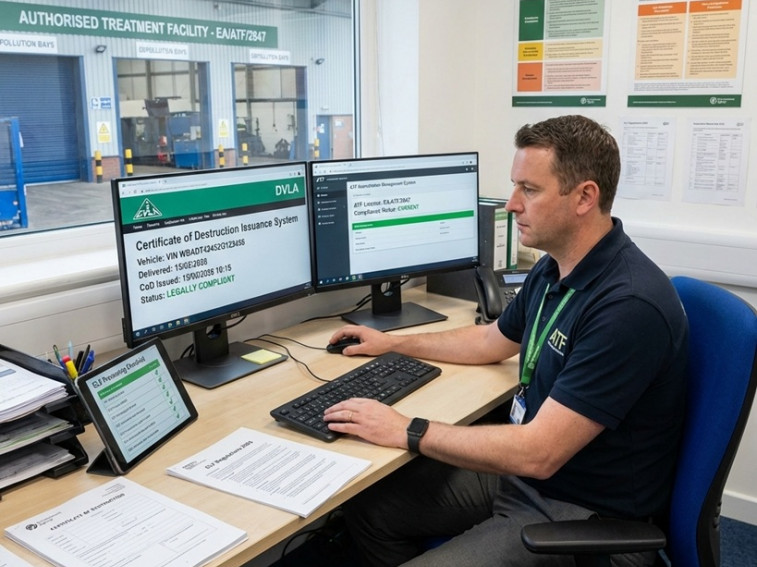
When a vehicle is scrapped at an Authorised Treatment Facility (ATF), the ATF issues a Certificate of Destruction (CoD), which legally confirms the vehicle has been destroyed. The V5C is no longer needed once the CoD is issued, as the vehicle ceases to exist in the eyes of the DVLA. The ATF notifies the DVLA directly, removing the vehicle from the register. For buyers purchasing Cat B vehicles for parts, you do not need to transfer the V5C into your name. Instead, ensure the CoD is issued promptly by the ATF to avoid any administrative confusion.
For buyers sourcing larger salvage vehicles such as commercial vans and HGVs, V5C handling follows the same principles but may involve additional weight classification documentation. Once the vehicle is delivered to the ATF, the V5C becomes obsolete, and the CoD takes precedence. If you regularly source vehicles for breaking, such as those available through vehicle auctions, maintaining organised records of both V5Cs and CoDs is a professional best practice.
V62 Replacement Applications: When V5C Documents Are Missing
In some cases, you may purchase a salvage vehicle without a V5C. This can happen if the document has been lost, destroyed, or retained by the insurance company during the claims process. When this occurs, you must apply for a V5C replacement using the V62 form, which can be completed online or via post.
How to Apply for V62 Replacement
The V62 replacement application requires proof of your identity, proof of the vehicle's details, and an explanation of why the V5C is missing. The DVLA will review your application and, if approved, issue a new V5C listing you as the registered keeper. Be aware that the V62 process can take several weeks, so plan accordingly if you need to tax or insure the vehicle quickly.
If the vehicle is a salvage category (Cat S or N), you must provide evidence that the vehicle has been repaired to a roadworthy standard before the DVLA will issue the V5C. This typically involves submitting an MOT certificate and, in some cases, photographs or an engineer's report confirming the repairs meet safety standards. This step is non-negotiable for Category S vehicles, which have structural damage that must be professionally rectified.
For buyers who prefer sourcing salvage vehicles with complete documentation to avoid V62 delays, platforms like RAW2K provide transparent auction listings where V5C status is clearly indicated. Choosing auctions that prioritise detailed vehicle information reduces the administrative burden and allows you to focus on repair or resale rather than paperwork.
DVLA Submission Procedures: Ensuring Accurate Registration
Once you have completed Section 6 of the V5C, it must be sent to the DVLA for processing. The DVLA will then update their records to reflect you as the new registered keeper and issue a new V5C in your name. This process typically takes 2-4 weeks, though delays can occur during peak periods.
Tracking Your Submission
After posting the V5C to the DVLA, it is wise to use a tracked postal service to confirm delivery. The DVLA does not issue automatic confirmation of receipt, so tracking provides peace of mind that your documents have arrived. If you do not receive your new V5C within 4 weeks, contact the DVLA to investigate the delay.
For vehicles that require additional checks (such as Category S vehicles), the DVLA may request further documentation or arrange an inspection before issuing the V5C. This is standard procedure and ensures that only roadworthy vehicles are re-registered. Patience and cooperation during this stage are essential for maintaining a positive relationship with the DVLA and avoiding re-submission fees.
Common Errors to Avoid
Mistakes in V5C submissions can cause significant delays. The most common errors include:
-
Incorrect VIN: Ensure the VIN you enter matches the vehicle exactly, including all letters and numbers.
-
Missing signatures: Both the seller and buyer must sign the relevant sections.
-
Wrong keeper details: Double-check your name, address, and postcode before submission.
-
Failure to include MOT evidence: For Cat S vehicles, always include a valid MOT certificate.
Avoiding these errors saves time and reduces frustration. If you are unsure about any part of the process, the DVLA's online guidance is comprehensive and easy to follow. Alternatively, professional salvage buyers often develop standardised checklists to ensure every V5C submission is completed accurately.
Navigating Complex Scenarios with V5C Documentation
Some salvage vehicle transactions involve unique circumstances that require additional care when handling the V5C. Understanding these scenarios prepares you for edge cases that occasionally arise.
Vehicles with Outstanding Finance
If a salvage vehicle has outstanding finance, the finance company technically owns the vehicle until the debt is cleared. In such cases, the V5C may list the registered keeper, but the buyer does not have legal ownership until the finance is settled. Reputable auction platforms screen vehicles for outstanding finance before listing, but private sales or less regulated platforms may not. Always run an HPI check before purchasing any salvage vehicle to confirm there are no financial encumbrances.
If you inadvertently purchase a vehicle with outstanding finance, contact the finance company immediately to negotiate a settlement. Once the debt is cleared, the finance company will release the vehicle, and you can proceed with the V5C transfer. This situation is rare in professional auctions but common in private salvage sales.
Vehicles Imported from Abroad
Salvage vehicles imported from abroad require special attention during V5C processing. The DVLA must confirm that the vehicle meets UK safety and emissions standards before issuing a V5C. This process involves submitting additional documentation, including proof of import, proof of insurance, and potentially an Individual Vehicle Approval (IVA) certificate.
For buyers focused on UK-sourced salvage vehicles, sticking to domestic auctions simplifies the V5C process significantly. Platforms like RAW2K specialise in UK vehicle auctions, ensuring all vehicles comply with domestic regulations and have straightforward V5C documentation.
Final Steps: Ensuring Compliance and Peace of Mind
Handling V5C documents correctly is a cornerstone of professional salvage vehicle trading. Whether you are repairing vehicles for resale, breaking them for parts, or scrapping them entirely, following DVLA documentation submission procedures meticulously protects you from legal and financial complications. By treating the V5C as a critical administrative tool rather than a mere formality, you demonstrate professionalism and build trust with customers, auction platforms, and regulatory bodies.
For buyers ready to source salvage vehicles with clear, complete V5C documentation, registering with trusted auction platforms ensures access to transparent listings and reliable support throughout the purchase process. If you have questions, you can contact platform support. Thousands of professional traders rely on RAW2K for salvage vehicle acquisition because of the platform's commitment to accurate documentation and customer service. Whether you are a first-time salvage buyer or an experienced dealer, managing your V5C handling correctly is the foundation of long-term success in this rewarding industry.