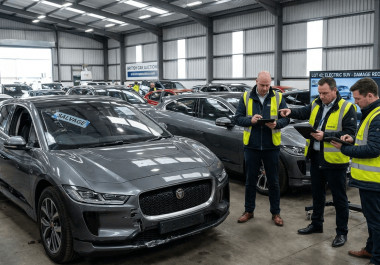
A beautifully repaired Category S prestige saloon sits at auction boasting a full service history and minimal mileage. The digital hammer price hovers at roughly forty percent below the clean retail equivalent. Despite the clear mathematical advantage, many inexperienced trade buyers walk away. They abandon the acquisition because a persistent industry rumour suggests the vehicle will be impossible to cover legally for the road. Believing this narrative costs commercial operators substantial profit margins every single day.
That exact scenario repeats itself constantly across the UK motor trade. The salvage insurance myth has circulated through the sector for years. It carries severe financial consequences for operators who accept the narrative without conducting independent market research. The reality is considerably more nuanced and significantly more buyer-friendly than general forecourt gossip suggests.
Recorded vehicles can definitely secure comprehensive coverage. Category S and Category N chassis are actively underwritten by a wide range of specialist brokers and specific mainstream providers across the country. The acquisition process is distinct, the financial overheads are elevated, and the application demands absolute historical transparency. However, coverage genuinely exists and remains highly accessible for trade professionals seeking to prove retail viability to their end-consumers.
Where the Myth Actually Originates
The narrative surrounding uninsurable write-offs contains a small kernel of truth that has been wildly exaggerated. Specific mainstream underwriters do automatically decline to cover recorded vehicles, particularly those possessing a history of structural chassis damage. When retail consumers utilize generic comparison platforms and encounter a wall of declined applications or mathematically absurd quotes, they incorrectly conclude that the broader market refuses to touch the asset.
The core issue lies entirely within digital comparison limitations. Many automated aggregator engines lack the sophisticated algorithms required to accurately process specific salvage categorisations. The resulting automated declines do not represent actual industry policy. They simply represent software limitations. Trade professionals sourcing inventory through active vehicle auctions understand that stopping at generic comparison sites means missing the dedicated specialist sector entirely.
Furthermore, severe misunderstanding surrounds the term "write-off" within the retail market. An underwriter declaring a vehicle a total loss is executing a strict economic decision, rather than rendering a judgement on future roadworthiness. A Category N hatchback written off for scraped panels might remain mechanically flawless. A Category S vehicle featuring professionally rectified structural damage easily passes stringent independent MOT testing. Neither asset is inherently uninsurable based on those historical facts alone.
What Category S and Category N Mean for Underwriters
The specific salvage classification heavily influences the final underwriting decision. Understanding this distinction is mandatory before attempting to calculate total commercial acquisition costs.
Category S classifications indicate historical structural damage to the core chassis or primary crumple zones. Rectifying this damage requires professional alignment equipment, and underwriters typically demand verifiable documentation to confirm the asset meets original manufacturer safety parameters. Securing coverage for these assets typically requires navigating toward dedicated specialist brokers. Mainstream providers frequently decline these profiles entirely.
Category N vehicles feature strictly non-structural damage. This encompasses cosmetic panel issues, interior vandalism, or complex electrical faults that never compromised the fundamental safety geometry. These units are substantially easier to underwrite. Certain mainstream providers will actively cover Category N inventory provided the applicant offers total historical disclosure upfront.
The resulting salvage vehicle premium varies dramatically based on the provider, the asset value, and the driver demographics. Market data indicates a standard increase of 10 to 20 percent above clean equivalents for Category N assets. Category S units frequently attract increases ranging from 20 to 50 percent. These elevated overheads represent a real market friction point that trade professionals must factor into their initial bidding calculations.
The Specialist Market That Actually Exists
The specialist underwriting sector operates successfully because consistent market demand requires it. These dedicated companies evaluate recorded vehicles as standard daily business rather than high-risk edge cases. Trade professionals frequently cultivate relationships within this sector to assist their retail buyers in securing coverage post-sale.
Several well-known specialist brokers actively target the modified and non-standard vehicle market. Brokers provide the most efficient route to securing viable cover. A broker operating within this specific sector holds established relationships with multiple specialist underwriters. They possess the capability to execute soft searches across the market without leaving damaging hard footprints on the applicant's digital file. Commercial operators tracking specific inventory across vehicle auctions in the North West rely heavily on these brokers to confirm retail viability before committing capital.
The disclosure requirements demanded by these specialists are remarkably straightforward. Applicants must accurately declare the exact salvage category and confirm all rectifications are fully complete. Supporting documentation is mandatory. This typically includes detailed bodyshop invoices, an independent engineer report confirming roadworthiness, and a current V5C logbook.
Arming Retail Buyers with Agreed Value Options
One highly effective mechanism that commercial operators utilize to close high-value restorations is the agreed value policy. Standard retail policies exclusively settle claims based on the current market value at the exact time of the incident. For recorded assets, that market value is permanently suppressed by the historical V5C marker, regardless of how much capital the operator invested into the rebuild.
Trade professionals overcome this retail friction point by educating their buyers about agreed value options. An agreed value policy successfully locks the insured value at a specific figure negotiated directly between the retail buyer and the specialist underwriter at inception. If a commercial bodyshop invests heavily to rectify a high-specification Category S chassis that is genuinely worth £12,000, they reassure the hesitant retail buyer by proving the asset can be protected for its true restored value, rather than a suppressed automated database figure of £7,000.
These specialized policies do command a higher financial premium for the end-consumer than standard market value cover. However, for premium assets demanding substantial workshop investment, the financial protection offered easily justifies the differential. Trade professionals frequently cultivate broker connections to explicitly offer these agreed value solutions when negotiating the final sale on the forecourt.
How the Financial Overhead is Actually Calculated
Underwriters do not generate quotes by applying random financial penalties to a standard baseline. They evaluate the exact same demographic factors used for clean vehicles, including driver age, geographic location, historical claims data, and annual mileage projections. They subsequently apply a specific mathematical weighting to account for the historical salvage marker.
An experienced 45-year-old driver possessing a clean history who requires cover for a Category N commuter vehicle in a rural postcode might only face a 10 percent increase over a clean equivalent. Conversely, a 22-year-old driver attempting to cover the exact same asset in a dense urban environment will face severe financial loadings, frequently exceeding 50 percent. When these specific demographic combinations render an asset genuinely uninsurable for the retail market, trade operators occasionally utilize a dedicated scrap my car service to rapidly liquidate the unviable chassis and recover baseline working capital.
This massive demographic variance explains why executing independent market research is mandatory. Relying on generalized forum gossip regarding insurance costs guarantees inaccurate commercial forecasting. Running exact demographics through specialist brokers reveals the precise salvage vehicle premium the end-consumer will ultimately face.
Practical Steps to Securing Coverage
Approaching the underwriting process correctly prevents wasted administrative effort. Implementing a strict verification process works reliably across all vehicle types and demographic profiles.
The process begins by compiling an airtight documentation folder. Trade sellers must provide their retail buyers with itemized repair invoices, a fresh MOT certificate confirming no structural advisories, any relevant alignment data, and the updated V5C. Supplying this verified intelligence immediately answers the underwriter's primary risk questions.
Professionals advise testing the market by contacting specialist brokers directly. Relying on generic aggregator platforms ensures inaccurate data collection. Comparing the total annual premium hike against the initial purchase saving dictates whether the acquisition holds genuine commercial logic.
Maintaining this documentation trail is vital for long-term ownership. Retaining subsequent clean MOT certificates and routine maintenance invoices protects the owner during future renewal negotiations. A strong historical record prevents the annual premium from drifting upward based on automated statistical assumptions.
Evaluating the True Cost Comparison
The salvage insurance myth persists primarily because inexperienced retail participants execute flawed mathematical calculations. They assume elevated premiums instantly eradicate any initial purchase savings. While this holds true for highly specific high-risk demographic combinations, it remains mathematically false for the vast majority of standard commercial transactions.
Consider the practical financial breakdown professional operators utilize on the forecourt. A trade buyer acquires and retails a Category N hatchback for £4,500, whereas the clean equivalent demands £8,000. The initial capital saving for the retail consumer is £3,500. If the specific salvage vehicle premium costs the retail driver £150 more annually than a clean policy, the trade professional uses this exact mathematics to close the sale. Over a standard five-year retail ownership cycle, the additional overhead totals £750. The net financial advantage to the end-consumer remains an impressive £2,750. Operators evaluating stock across diverse regional hubs, such as vehicle auctions in Wales, utilize this exact long-term formula to prove long-term financial viability to hesitant retail buyers.
Category S calculations are admittedly tighter due to steeper premium weightings. However, because structural write-offs transact at substantially lower initial price points, the wider acquisition margin frequently absorbs the elevated insurance costs comfortably.
The Severe Consequences of Non-Disclosure
The most destructive error a buyer can make involves deliberate historical concealment. Attempting to suppress a Category S or Category N marker does not generate genuine commercial savings. Underwriters who receive accurate intelligence and agree to the risk are legally bound by the policy. Underwriters who uncover a concealed marker post-inception possess the legal right to void the policy instantly.
A voided policy guarantees zero financial payout during a claim, regardless of whether the concealed history contributed to the specific incident. Furthermore, deliberate non-disclosure exposes the applicant to severe fraud prosecution risks. The temporary financial relief gained through deception completely collapses when a legitimate claim is required.
Total transparency protects the asset during the crucial renewal phase. When an underwriter accepts the risk profile upfront, that initial agreement establishes a stable foundation for future premiums. When a marker is discovered retroactively during a routine database sweep, the commercial relationship terminates immediately.
Testing the Market Prior to Bidding
The most effective strategy for neutralizing insurance friction involves testing the market before deploying capital. This requires utilizing the detailed intelligence provided on digital auction listings to run hypothetical quotes prior to the auction concluding.
Initiating a soft search process through a specialist broker reveals the exact financial resistance a specific asset will generate. If the quote returns at an unmanageable level, the trade buyer simply adjusts their maximum bid downward or abandons the lot entirely. Buyers evaluating highly specific inventory, such as analyzing active motorcycle auctions, rely heavily on this pre-bid intelligence to protect their working capital.
Transparent digital gateways provide exact salvage categories, detailed damage descriptions, and high-resolution imagery. This comprehensive data allows commercial operators to gather accurate underwriting estimates long before the digital hammer falls.
The Myth Versus the Commercial Reality
The persistent salvage insurance myth insists that recorded vehicles are dead assets incapable of securing legal road coverage. The commercial reality proves they are highly insurable through a robust network of dedicated specialist providers. The premiums are undeniably elevated, but they remain highly quantifiable and mathematically viable for the majority of the retail market.
The myth suggests disclosure guarantees an automatic decline. The reality demonstrates that total disclosure is the exact mechanism that unlocks specialist coverage. The myth claims repair investments cannot be protected. The reality highlights agreed value policies as the definitive solution for high-value restorations.
Insuring a recorded asset requires a different administrative approach compared to a clean vehicle. It demands specialist brokers, comprehensive repair documentation, and an acceptance of elevated baseline overheads. However, requiring a different process does not render the task impossible. Commercial operators who understand this distinction secure highly profitable inventory while their misinformed competitors walk away empty-handed.
If trade professionals require assistance with account verification or have questions regarding tier-based buyer fees, please contact our customer support team for immediate guidance.
To apply this professional due diligence to live inventory and build a highly profitable acquisition strategy, secure auction bidding access today.
Once registered, professionals can immediately evaluate the extensive catalog of trade inventory available across the RAW2K digital gateway.