Spotting a bargain at auction comes from what the seller shows. Spotting a money pit comes from what they don't. Too many buyers get burned by vehicles that looked pristine on the surface but had a history of botched repairs hidden underneath. The seller's photos show a gleaming bonnet and fresh paintwork, but three months later, there's rust blooming through or panels that don't quite line up. It's frustrating, costly, and entirely avoidable with knowledge of what to look for.
Undisclosed repairs aren't always about dodgy sellers trying to pull a fast one. Sometimes it's genuine ignorance. The previous owner had work done and never thought to mention it. Other times, it's deliberate concealment. Either way, the result's the same: ending up with a vehicle that's worth less than paid, or worse, one that's unsafe.
Here's what needs watching for when inspecting any vehicle, whether at salvage vehicle auctions or private sales. These repair concealment indicators have saved thousands over the years, and they'll do the same for careful buyers.
Paint and Bodywork Inconsistencies
Fresh paint on a used vehicle isn't automatically suspicious. But fresh paint that doesn't match the rest of the car? That's a red flag waving.
Paint texture analysis starts by running hands along the panels. Quality factory paint has a consistent texture and finish. Repaired sections often feel different. Either rougher from overspray or too smooth where someone's flatted it back.
Check the paint in different lighting conditions, especially natural daylight. Mismatched colours become obvious when the sun hits them at an angle. Look for overspray on rubber seals, window trim, or light lenses. Professional body shops mask these areas properly. Rushed repair jobs don't. If paint appears where it shouldn't be, someone's taken shortcuts, and shortcuts in bodywork usually mean problems elsewhere too.
Orange peel texture, that dimpled look sometimes seen in paint, is normal on modern factory finishes. But if one panel has it and the adjacent panel doesn't, that's evidence of repainting. Similarly, conduct paint texture analysis checking for thickness variations by examining the edges of doors and bonnets. Factory paint is thin and even. Repair paint builds up in layers.
One Golf GTI buyer thought he'd found a pristine example. Looked immaculate in the photos. When he collected it, running a thumb along the rear quarter panel revealed the telltale edge where new paint met old. Turned out it had been rear-ended and poorly repaired. He'd have spotted it himself if he'd known to check.
Panel Gaps and Alignment Issues
Factory-fitted panels line up perfectly. It's not magic. It's precision engineering and jigs that hold everything in place during assembly. When panels have been removed and refitted, or worse, replaced with aftermarket parts, those tolerances go out the window.
Stand at each corner of the vehicle and look along the body lines. Doors, bonnets, and boot lids should sit flush with adjacent panels, with consistent gaps all the way around. If one side has a 3mm gap and the other has 6mm, that panel's been off.
Bonnet alignment is particularly telling. Open and close it a few times. Does it drop into place easily, or does it need pushing down? Does it sit level, or is one side higher? A wonky bonnet usually means front-end damage that's been repaired.
Check the door gaps with the doors open and closed. Inconsistent gaps suggest the door's been removed. Possibly to access damaged structure behind it, or because the door itself was replaced. Look at the hinges too. Fresh paint on hinges or new bolts are evidence of recent work.
Boot and tailgate alignment matters just as much. Rear-end shunts are incredibly common, and many get repaired without proper documentation. If the boot doesn't close smoothly or the gaps aren't even, someone's been working back there. Thorough panel gap inspection catches these issues before money changes hands.
Welding Marks and Structural Repairs
This is where things get serious. Cosmetic repairs are one thing. Structural repairs affect the vehicle's safety and integrity, and they absolutely must be disclosed.
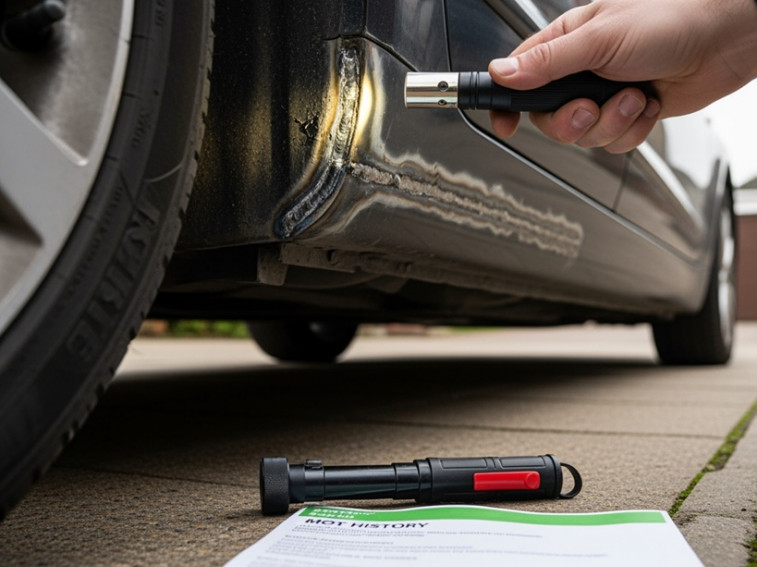
Get underneath the vehicle if possible, or at minimum, look up into the wheel arches. Factory weld identification shows that factory welds are neat, consistent, and often have a specific pattern. Repair welds look different. Rougher, more irregular, sometimes with splatter marks around them.
Check the chassis rails, suspension mounting points, and anywhere two pieces of metal join through factory weld identification techniques. Seam sealer is another giveaway. Manufacturers apply seam sealer in specific patterns using machines. It's consistent and neat. Hand-applied seam sealer looks messier, with finger marks or uneven application. If fresh seam sealer appears anywhere on the structure, someone's been doing structural repairs.
Look for paint on bolts and fixings in the engine bay and underneath. These shouldn't be painted. If they are, it's because someone's sprayed over them during repairs. Similarly, check for new bolts mixed with old ones. A sign that parts have been replaced.
Suspension mounting points are critical. Any welding or repairs here should trigger walking away unless there's a massive discount and exact knowledge of what's being dealt with. Cars with cracked suspension mounts that had been welded up and painted over aren't just poor workmanship. They're dangerous. Proper factory weld identification prevents buying these hazards.
Mismatched or Aftermarket Parts
Manufacturers don't mix and match parts from different model years or specifications. If looking at a 2018 vehicle with a headlight from a 2020 model, someone's replaced it. That's not necessarily bad, but it raises questions.
Check part numbers if visible. They're usually stamped or printed on plastic components. Headlights, tail lights, bumpers, and trim pieces all have identifying marks. If the parts don't match the vehicle's age and specification, they've been replaced.
Aftermarket parts detection is crucial. Aftermarket parts have their place, but they're often fitted after accident damage because they're cheaper than genuine parts. Look for quality differences through aftermarket parts detection techniques. Aftermarket bumpers often have thinner plastic, different textures, or don't fit quite as well as original equipment. The same goes for lights. Aftermarket units usually have less crisp lenses and cheaper internal components.
Interior parts can tell about undisclosed repairs too. If the airbags have deployed, they need replacing. New airbag covers look different from old ones. The plastic's lighter in colour, and the stitching's cleaner. Check the steering wheel, dashboard, and seats for new covers or replacement parts.
Wing mirrors are another common replacement item. If one mirror's pristine and the other's weathered, the pristine one's been replaced. Why? Usually because someone clipped it, and often that same incident caused other damage they haven't mentioned. This is particularly common on salvage motorcycle auctions where minor incidents often go undocumented.
Unusual Wear Patterns and Corrosion
Vehicles age in predictable ways. Stone chips on the bonnet, worn driver's seat bolster, faded plastic trim. These are normal. But if a five-year-old car has a brand-new bonnet with no stone chips while the rest of the vehicle shows its age, that bonnet's been replaced.
Check for corrosion in unusual places. Rust around repair areas appears faster than elsewhere because the protective coatings have been compromised. If rust appears on a panel that's supposedly been recently repaired, the repair was done poorly, without proper preparation or protection.
Look underneath for evidence of filler. Body filler's used to smooth out dents and damage before painting. It's not necessarily a problem if used properly, but excessive filler or filler in structural areas is a major concern. Spotting it often comes from the slight difference in surface texture, or by using a magnet. Filler isn't magnetic, so a magnet won't stick where there's thick filler.
Tyre wear tells about suspension damage. If the vehicle's supposedly never been in an accident but has uneven tyre wear, worn suspension bushes, or a steering wheel that's off-centre, it's likely had an impact that's knocked the geometry out. That impact may well have caused other structural repair evidence that hasn't been disclosed.
Documentation Gaps and Inconsistencies
Service history should be complete and consistent. Gaps in the history, especially around the time repairs might have been done, are suspicious. If a vehicle was serviced regularly and then has an 18-month gap before the next service, something happened during that gap.
Look for insurance documents or repair invoices in the history. Their absence doesn't prove anything, but their presence confirms repairs. Some sellers accidentally leave paperwork in the glovebox. Always worth checking.
The V5C registration document shows the vehicle's colour. If the document says blue but the car's red, it's been resprayed and the DVLA hasn't been notified. That's a legal requirement if the colour's changed significantly, and skipping it suggests other shortcuts have been taken.
MOT history is gold for spotting undisclosed repairs. Check it online for free through the government's MOT history service. Look for advisories and failures that mention damage, corrosion, or structural issues. If a vehicle failed an MOT for a cracked subframe and then passed a week later, someone's repaired it. That repair should have been disclosed.
Compare the mileage in the MOT history with the current reading. Discrepancies suggest clocking, which often accompanies other forms of deception. If someone's willing to roll back the odometer, they're probably willing to hide repair history too.
What This Means for Auction Buyers
When bidding at auctions, working from photos and descriptions means hands can't run over panels or check welding. That's why extra caution is needed and potential hidden repairs must factor into bidding strategy.
Read the condition report thoroughly. Reputable auction platforms document known damage and repairs. If something's been disclosed, it's priced accordingly. It's the undisclosed stuff that costs money.
Look closely at photos for repair concealment indicators mentioned above. Zoom in on panel gaps through panel gap inspection techniques, check paint reflections for inconsistencies, and look for overspray or mismatched parts. Not everything will be spotted, but the obvious ones will be caught.
For vehicles with declared categories (Cat S or Cat N), previous repairs are expected and documented. That's actually safer in some ways than buying a vehicle with undisclosed repairs, because at least the situation is known.
For commercial vehicles like vans, previous repairs are incredibly common. Vans get used hard, they get bumped, and they get fixed. What matters is whether the repairs were done properly and honestly documented. A van with disclosed, professional repairs can be excellent value. One with hidden bodges will cost a fortune.
The HPI and History Check
Before bidding on anything, run an HPI history check or equivalent vehicle history report. These services search insurance databases for recorded accidents and claims. If a vehicle's been in a significant accident that went through insurance, it'll show up.
But here's the catch: not all repairs go through insurance. If the previous owner paid for repairs privately to avoid affecting their no-claims bonus, there won't be a record. That's legal and sometimes sensible, but it means the HPI history check won't catch it.
History checks also reveal if a vehicle's been written off and repaired. Category S (formerly Cat C) means structural damage. Category N (formerly Cat D) means non-structural damage. Both should be disclosed, and both affect value significantly. Many buyers specifically search write-off cars for sale because at least the damage history is transparent.
If buying what's supposedly an unrecorded vehicle and the HPI history check reveals a Cat S marker, walk away. Dealing with someone who's deliberately concealing information.
When to Walk Away Vs When to Negotiate
Not all undisclosed repairs are deal-breakers. A poorly documented bumper replacement on a van? Annoying, but probably not serious. Undisclosed structural welding on a family car? Absolutely walk away.
Use what's found as negotiation leverage. If evidence of repairs that weren't mentioned appears, renegotiation or withdrawal is justified. Most sellers will reduce the price rather than lose the sale, especially when specific evidence can be pointed to.
But some things aren't negotiable at any price. Structural repairs that weren't done properly compromise safety. Excessive filler that's hiding serious corrosion will fail in months. Vehicles with clocked mileages and hidden accident damage are built on lies, and if someone's lied about one thing, they've probably lied about others. In severe cases, it's better to scrap the vehicle than risk the liability.
Trust instincts. If something feels wrong, it probably is. Walking away from dozens of vehicles over the years because something didn't add up has proven wise. Every single time, there was a problem that had been sensed but couldn't quite be pinned down. Subconscious pattern recognition spots issues before conscious mind catches up.
Protecting Yourself After Purchase
Even with careful inspection, something might be missed. That's why getting any vehicle properly checked after purchase is essential, especially if planning to sell it on or use it commercially.
Book it in with a trusted mechanic who'll put it on a ramp and check it thoroughly. Tell them about concerns regarding undisclosed repairs and want them to look specifically for evidence of bodywork, welding, or structural repair evidence. It'll cost a couple of hours' labour, but it's worth every penny.
If undisclosed repairs are discovered after purchase, legal recourse may be available. Sellers are required to disclose material facts that would affect the decision to buy. Hidden accident damage certainly qualifies. Document everything with photos and get written statements from mechanics. They might be needed.
For vehicles bought through RAW2K, the platform provides condition reports and dispute resolution processes. If something major was missed in the listing, get in touch quickly. The sooner an issue is raised, the more seriously it's taken.
Final Thoughts
Buying vehicles at auction is like any other skilled trade. Improvement comes with experience, but fundamentals must be learned first. Mastering identification of undisclosed repairs is fundamental. It's the difference between buying a bargain and buying someone else's problem.
Qualification as an engineer or body shop technician isn't necessary to spot most of these warning signs. Just knowledge of what to look for and time taken to look properly. Run hands over panels, check gaps and alignment through panel gap inspection, look for paint inconsistencies using paint texture analysis, examine factory weld identification markers, and scrutinise the documentation.
The best deals aren't always the cheapest vehicles. They're the ones where exact knowledge exists about what's being bought, including any repairs and history. A properly repaired Cat S vehicle with full documentation can be better value than an apparently clean car with hidden repairs. At least with the Cat S, the situation is known.
Take time, trust judgement, and never let excitement about a bargain override common sense. There'll always be another auction, another vehicle, another opportunity. But there's only one reputation and one set of finances worth protecting.
Need guidance on buying salvage vehicles? Check the help section or register to bid and start applying these inspection techniques to find genuine bargains.