Vehicle auctions present excellent chances to purchase motorbikes and scooters, often at very competitive prices. These auctions aren't exclusively for car dealerships. They offer private buyers a distinct source for restoration projects, spare parts, or economical transportation.
Achieving success in this specialised market depends significantly on comprehending the condition and classification of each item when sourcing motorbikes scooters in salvage auctions. This expert guide provides comprehensive advice for navigating the process, enabling you to make confident, well-informed acquisitions.
We'll cover all essential information, from evaluating damage categories to organising secure collection. Explore motorcycle auctions to view the current two-wheeled selection available across the UK.
The Unique Appeal of Two-Wheeled Auctions
Motorcycles and scooters represent a distinct auction category. They appeal to a broad range of buyers, from those seeking specific rare models to professional businesses looking for commercial fleet units.
They typically require less storage space and can sometimes yield higher profit margins relative to their initial investment compared to cars. A damaged superbike taking up a fraction of garage space can offer returns matching or exceeding those from larger vehicles.
Learning about the different factors that bring motorbikes scooters in salvage auctions is the first step in successful sourcing.
Why Motorbikes Enter the Salvage Stream
Unlike cars, motorbikes are inherently more vulnerable in accidents. Their exposed nature means even minor collisions often lead to total insurance write-offs. A car might sustain a scraped bumper in an incident that completely destroys a motorcycle's fairings, exhaust, and suspension components.
They frequently end up in vehicle auctions after incidents involving theft recovery, collision damage, or severe weather events. This high write-off rate means high-quality, low-mileage examples sometimes appear in the salvage category with repairable faults.
The economics of motorcycle insurance claims differ substantially from cars. A £2,000 repair bill on a three-year-old motorcycle valued at £4,500 will often trigger a write-off, whereas the same percentage wouldn't necessarily write off an equivalently valued car.
However, motorbikes can also enter the auction from police seizures or finance repossessions. These often come as complete, running units with clear titles, requiring only documentation updates. Seized bikes frequently represent exceptional value as they haven't sustained accident damage.
Key Factors Driving Buyer Demand
The demand for two-wheeled auction lots is split between professional breakers seeking valuable engine or fairing components, and enthusiasts looking for weekend projects.
Scooters and commuter bikes are often sought after for economic urban transport. Models like the Honda PCX or Yamaha NMAX consistently attract attention due to their fuel efficiency and low running costs. Even with moderate damage, these practical machines find ready buyers.
High-performance motorbikes attract buyers keen on restoration or track-day use. Salvaged sportbikes like the Yamaha R6 or Kawasaki Ninja models often have intact engines worth £1,500-3,000 alone, making them valuable even when the bodywork is destroyed.
Popular Models in the Salvage Market
Certain motorcycle types appear more frequently in salvage auctions due to their market prevalence and usage patterns. Delivery scooters (Honda Vision, Piaggio Liberty) see heavy urban use, leading to regular minor accidents that create salvage opportunities.
Sports tourers like the BMW R1250GS frequently appear following off-road incidents. Their adventure-touring design encourages riders to venture into challenging terrain, occasionally resulting in drops or slides that damage panelling whilst leaving the robust engine and frame intact.
Classic British motorcycles (Triumph, Norton) appear occasionally, offering restoration enthusiasts access to models that would be prohibitively expensive in undamaged condition. A salvaged Triumph Bonneville might need £3,000 in parts and labour but still cost half the price of a pristine example.
Crucial Pre-Bidding Checks for Motorbikes
Thorough pre-bid due diligence is arguably more important for a motorbike than for a car. Mechanical faults can sometimes be less visible on two-wheelers, and the consequences of hidden damage more severe.
Since physical inspection isn't always available, remote assessment of the listing details is absolutely critical to avoid costly surprises. Always approach your sourcing strategy with a rigorous, fact-based mindset, keeping salvage motorbike buying tips in mind.
Understanding Motorcycle Salvage Categories (N and S)
Like their four-wheeled counterparts, motorbikes are classified by the severity of their damage. A Category N (Non-structural) motorbike has superficial or mechanical damage that doesn't affect the frame. This makes it a viable repair option for many hobbyists.
Category N bikes might have damaged fairings, bent handlebars, or cracked instrument clusters—all repairable without specialist frame equipment. These represent the lowest-risk salvage purchases for DIY restorers.
A Category S (Structural) motorbike, however, has suffered damage to the chassis or frame. This means its structural integrity is compromised and professional frame repair is necessary before it's deemed roadworthy.
Inspecting a Category S motorbike's frame geometry is like checking the foundations of a house. If the base is bent, every subsequent repair will be difficult, time-consuming, and expensive. Frame straightening requires specialist jigs and alignment equipment typically costing £500-1,200 in professional fees alone.
For bikes beyond economic repair, arranging scrap collection ensures proper disposal whilst potentially recovering valuable components like engines and wheels.
Detailed Remote Inspection Steps
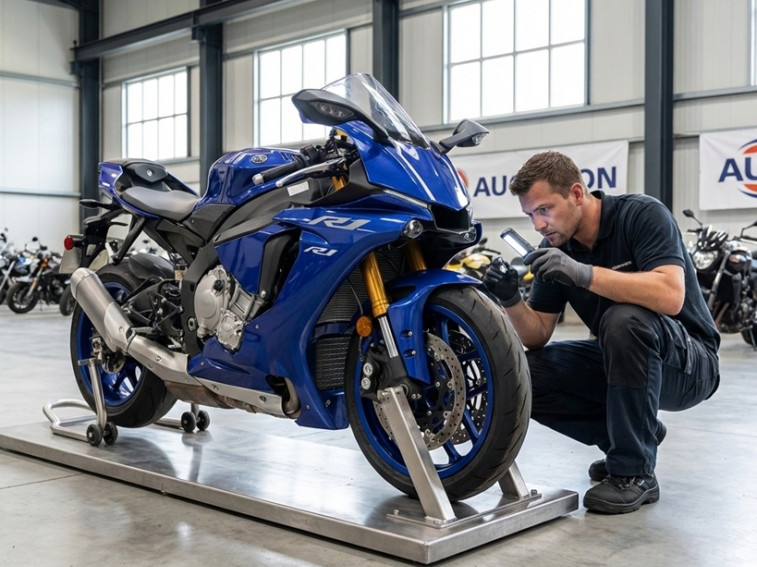
When you can't physically examine the bike, pay close attention to the photographs for symmetry and alignment. Key inspection points include:
Fork and Swingarm Damage: Check for damage to the forks, swingarm, and handlebar alignment, which are common indicators of frame or major component stress. Look for bent fork tubes (visible as misalignment between triple clamps), twisted swingarms, or handlebars pointing at angles to the front wheel.
Footpeg and Bracket Condition: Damaged or missing footpegs usually indicate a slide or drop. Check mounting brackets for bending or stress fractures, which suggest the impact force may have transmitted into the frame.
Engine Casing Examination: Motorcycle engines have exposed crankcases vulnerable to impact damage. Cracks in engine casings can be expensive to repair, requiring specialist welding or complete engine replacement.
Wheel and Brake Condition: Bent wheels are surprisingly common in salvage motorcycles. Check photos carefully for oval-shaped wheels or damaged rims. Brake disc warping is another red flag, visible as discolouration or obvious distortion in photos.
Vehicle Description Review: Always read the vehicle description to note any mention of missing keys, service history, or recorded mechanical faults. Motorcycle keys can cost £150-300 to replace for modern bikes with immobiliser chips.
VIN History Check: Requesting the VIN is essential to perform a history check, confirming the bike's previous ownership, MOT history, and any potential outstanding finance. Motorcycle finance agreements are common, making this check critical.
Documentation Status: Verify the availability of the V5C registration document for smooth ownership transfer. Missing V5Cs add delay and £25 DVLA replacement fees.
Common Fault Patterns by Motorcycle Type
Different motorcycle categories exhibit predictable damage patterns that informed buyers should recognise:
Sportbikes: Often suffer fairings damage from slides in corners. Check for engine case damage (stator cover commonly ground away), bent clipon handlebars, and damaged rearsets. These parts are expensive but usually don't compromise structural integrity.
Adventure Bikes: Frequently show damage from off-road drops. Look for bent crash bars, damaged pannier mounts, and scratched cylinder head covers. Frame damage is less common due to protective crash bars, but check carefully.
Scooters: Commonly damaged in urban low-speed accidents. Front panels, mirrors, and leg shields take most damage. Mechanical components usually survive intact, making these excellent value purchases.
Cruisers: Heavy weight means drops often result in significant cosmetic damage. Fuel tanks, primary covers, and exhaust systems are vulnerable. Check for twisted handlebars and damaged forward controls.
Documentation and Roadworthiness Considerations
If you win a non-salvage motorbike, you can generally expect the necessary V5C registration document to be included, simplifying the ownership transfer. The DVLA typically processes motorcycle ownership changes within 2-4 weeks.
For a salvage bike, you must factor in the time and expense of the process required to return it to the road. This includes a stringent MOT and potentially a professional structural assessment for Category S models.
Motorcycles require MOTs from three years old, but salvage bikes need immediate testing regardless of age. MOT testing stations charge £29.65 for motorcycles under 200cc and £37.80 for larger bikes.
Ensure you know the steps required to establish legal ownership, especially when bidding on police-seized assets. This preparation avoids bureaucratic delays after a successful auction for motorbikes scooters in salvage auctions. Browse all vehicle categories to compare motorcycle values against other salvage options.
Expert Salvage Motorbike Buying Tips and Bidding Strategy
A disciplined bidding strategy, informed by solid research, is the key to securing a great deal on a motorbike or scooter. Never let the excitement of the auction push you beyond your pre-set maximum budget.
Knowing when to jump into the live bidding is just as important as knowing when to step away from a lot. Emotional attachment to a specific model is the fastest route to overpaying.
Budgeting for Repair and Resale Value
When calculating your maximum bid, remember to include all non-bid expenses: the buyer's premium, VAT, collection costs, and the all-important repair budget.
For bikes, parts can sometimes be harder to source than car components. Japanese manufacturers (Honda, Yamaha, Suzuki, Kawasaki) maintain excellent parts availability, whilst European brands (Ducati, BMW, Aprilia) often require specialist suppliers with longer lead times and higher prices.
Factor in potential waiting times or the cost of specialised repairs. Wheel truing costs £40-80 per wheel, frame jig work £500-1,200, and fairings replacement £400-2,000 depending on the model. For high-performance bikes, original equipment manufacturer (OEM) fairings for a Yamaha R1 can cost £3,000+, whilst pattern parts might be £800-1,200.
For dealers, accurately calculating the final profitable resale value is essential. This requires a conservative estimate of the repair costs. This financial planning provides clarity in the fast-moving auction environment.
Calculating Maximum Bid: Worked Example
Consider a 2019 Honda CB500X adventure bike with Category N damage (broken screen, damaged pannier mounts, scraped engine bars). Market value when repaired: £4,200.
Repair costs:
-
Screen: £120
-
Pannier mounts: £80
-
Engine bars: £150
-
Labour (3 hours): £180
-
Total repairs: £530
Auction costs:
-
Buyer's premium (10%): Calculate on hammer price
-
Collection: £100
-
MOT: £37.80
-
Total additional: £137.80
Calculation: £4,200 (market value) - £530 (repairs) - £137.80 (costs) - £1,000 (profit target) = £2,532
Maximum hammer price: £2,300 (allowing for 10% buyer's premium = total £2,530)
This disciplined approach ensures profitability. Exploring vehicle auctions allows for comparing motorcycle opportunities against other vehicle types.
Using the Proxy Bid Feature Wisely
The live bidding platform allows you to place a proxy bid, setting your maximum price. The system then bids automatically on your behalf. This strategy is highly recommended as it protects your budget and removes the emotional element of bidding.
Consider Sarah, an experienced weekend restorer, who identified an affordable Category N scooter with minor panel damage. She set her proxy bid firmly at £400. Although the bidding went up, the system secured the scooter for her at £385, just enough to beat the competition, and well within her restoration budget.
Navigating Regional Auction Opportunities
Wide coverage across the UK means you can often find stock closer to your location, significantly reducing transport costs. Motorcycle transport typically costs £1.50-2.50 per mile for professional services, making local sourcing valuable.
Dealers looking for regional stock, such as those targeting specific commuter models, can use regional filters to save time. They identify vehicles that are easier and cheaper to collect. Commercial vehicle auctions also sometimes feature motorcycle delivery fleets worth investigating for bulk purchases.
Securing Your Purchase and Arranging Collection
Once the hammer falls and you are the winner, fast payment and organised collection are required to finalise the purchase. Secure payments must be made promptly through the online platform, usually within one to two business days of the auction close.
Failure to pay on time can result in penalties and the loss of the lot. Payment methods typically include bank transfer or debit card for smaller purchases.
Collection Logistics for Motorcycles
For collection, you must strictly follow the agreed-upon time slots provided by the regional auction centre. Unlike cars, motorcycles are easier to load but require proper securing equipment.
If your purchased motorbike is non-running, salvage, or seized, you must organise professional, appropriate transport in advance. Driving it away will not be permitted without valid insurance, MOT, and tax. Most buyers use motorcycle trailers, covered vans, or professional motorcycle transport services.
Bring photographic identification and proof of purchase to ensure a quick and smooth handover. Many auction centres require advance notice for motorcycle collections to ensure the bike is accessible and not buried under larger vehicles.
Ready to start sourcing two-wheeled stock? Register to access auctions and begin exploring motorcycle listings with confidence. New bikes and scooters are added regularly across all categories.
Motorbike and scooter auctions are an exciting segment of the vehicle market, offering great value for money and unique opportunities. By applying these specific salvage motorbike buying tips, performing thorough digital inspections, and sticking to a clear budget, you can bid with confidence and secure your next two-wheeled asset.
RAW2K Vehicle Auctions offers transparent listings and a secure bidding platform for motorcycles, scooters, and all vehicle types.