For professional motor traders across the UK, securing reliable, high-value stock at competitive prices is the cornerstone of a successful business model. Salvage auctions offer a strategic advantage over traditional trade sources by providing a diverse inventory of repairable, seized, and accident-damaged vehicles. Learning how to accurately assess the potential of these vehicles is the key to achieving significant car dealer profits. This guide outlines practical strategies for car dealers to consistently Boost Dealer Profits and maintain a competitive advantage in the retail market through RAW2K.
Sourcing High-Margin Inventory Through Salvage
The salvage market is a powerful resource for dealers seeking to diversify their stock and control acquisition costs. Unlike buying stock at premium prices from mainstream wholesale channels, sourcing via online auction platforms provides vehicles with inherent value that can be unlocked through professional repair. This opportunity allows trade buyers to purchase vehicles well below market value, which creates a much wider gap between acquisition cost and final retail price.
Salvage inventory, including cars, motorbikes, and even light commercial vehicles, represents excellent stock for quick turnaround sales. Dealers can access diverse vehicle listings to find speciality models, high-end parts, or popular makes that are currently in high demand. This steady stream of inventory is crucial for maintaining consistent sales flow throughout the year. Mastering the salvage acquisition process is an effective way to control overheads while expanding the range of vehicles offered to customers.
Understanding Category S and N for Resale
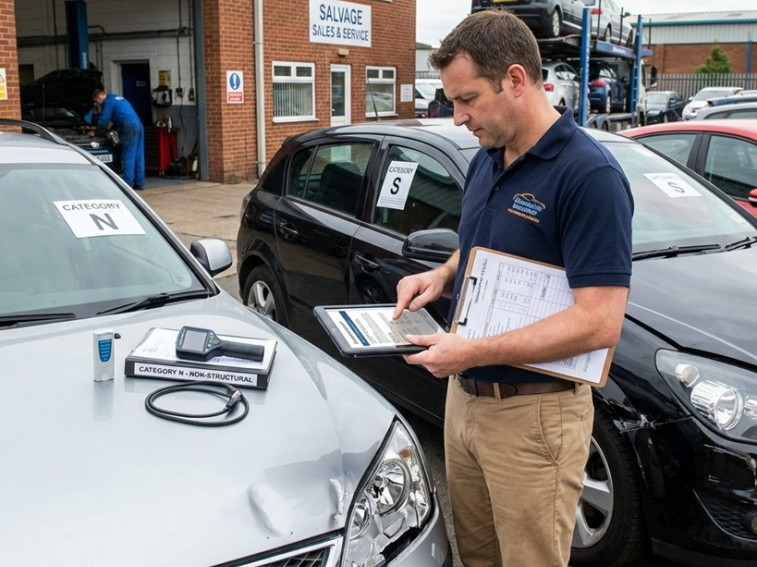
Professional assessment of the insurance category is where the true dealers' auction edge begins. Dealers must quickly distinguish between Category S and Category N vehicles to calculate viable repair projects. This rapid and accurate decision-making process is critical to maintaining high inventory turnover.
-
Category N (Non-Structural): These vehicles present the lowest risk for resale, as the damage is related to bolt-on panels, electrics, or mechanical systems. Repairs generally do not require specialist chassis jigs, making the turnaround time and cost highly predictable. Once repaired and passed through standard checks, they are ready for retail.
-
Category S (Structural): Though more complex, these vehicles often yield the largest margins because the initial hammer price is lower. Category S repairs demand expert, qualified attention and a thorough post-repair assessment. Dealers with in-house body repair capabilities can often realise the greatest returns from this stock.
Category A and B vehicles, while not road-repairable, remain vital to the trade for parts and dismantling. However, repairable Categories S and N form the backbone of a successful dealer's strategy for profitable resale stock.
Bulk Buying and Fleet Disposals
High-volume purchasing allows dealers to scale their operations and achieve significant economies of scale. Many auctions feature large consignment sales from fleet operators, local authorities, and financial institutions. Acquiring vehicles in bulk often streamlines logistics and spreads fixed costs, such as transport and administrative fees, across multiple units.
For dealers looking to diversify beyond standard cars, exploring commercial and leisure stock can open new revenue streams. The continuous supply provided by fleet disposal contracts facilitates this scaling for established businesses. Purchasing multiple vehicles from a single event simplifies the collection process and minimises downtime, ensuring stock levels remain robust to meet fluctuating market demand.
Gaining the Dealers' Auction Edge with Due Diligence
The biggest advantage a professional dealer holds over a private buyer is the ability to conduct fast, accurate, and profitable due diligence. This ability to assess a vehicle's condition remotely and calculate an immediate, viable repair cost is the core of the dealers' auction edge. By relying on detailed reports rather than emotional impulse, dealers ensure every acquisition is financially sound. This sharp, analytical approach prevents costly overbidding.
A skilled dealer knows that if the figures do not add up on the screen, the vehicle is not worth pursuing. This discipline is essential when sourcing vehicles in large quantities. The dealer's expertise transforms accident damage from a liability into a calculable asset, differentiating their strategy from that of casual buyers.
Accurate Repair Cost Estimation
Accurate forecasting is crucial for profitability. This requires current knowledge of parts, labour rates, and repair time. Dealers need established relationships with parts suppliers and trusted repair partners for fast, cost-effective turnarounds.
A methodical approach involves itemising damage for replacement parts and estimating bodywork hours. Subtracting the total repair costs from the expected retail value determines the maximum profitable hammer price, ensuring each acquired vehicle helps Boost Dealer Profits.
Leveraging Auction Data for Valuation
Modern digital platforms provide a wealth of data that replaces the need for physical inspection in most cases. Dealers must be experts at interpreting this digital evidence, including high-resolution images and condition reports. It is vital to scrutinise images of the undercarriage and engine bay for signs of deep water damage, or check the VIN for inconsistent history reports.
Trade buyers can utilise support resources and guides to better understand report terminology. Dealers can also check local market retail prices for similar repaired vehicles before the bidding begins. This comparison ensures their valuation ceiling remains commercially viable, protecting their investment against overspending.
Strategic Bidding for Maximum ROI
Professional bidding is a calculated financial exercise, not a game of chance. Dealers must apply the same rigour they use for repair cost estimation to their bidding process. The goal is to secure salvage inventory at the lowest possible price, ensuring the widest possible margin for refurbishment and retail.
Avoid the common pitfall of emotional bidding, which can cause an otherwise profitable vehicle to become a loss-making acquisition. Experienced trade buyers recognise that there will always be another similar vehicle in the next auction, enabling them to walk away if the price exceeds their limit.
Streamlining Logistics and Collection for Trade Buyers
Efficiency in the post-auction process is just as important as the acquisition itself. Delays in payment or collection can lead to unnecessary fees and prolonged vehicle downtime. To maintain margins, savvy dealers utilise regional auction centres to source stock closer to their primary business location.
Minimising transport costs is a simple yet effective way to increase the margin on every sale. A dealer based in the Midlands, for example, should focus on local listings to reduce recovery time. For questions regarding payment methods or collection deadlines, contacting the customer support team ensures a smooth transaction. This smart sourcing strategy ensures that every pound saved on logistics is a pound added to the final profit margin.
Boost Dealer Profits Through Strategic Auction Sourcing
Salvage auctions are essential tools for any car dealer seeking to expand inventory, control costs, and achieve superior profit margins. By mastering the evaluation of Category S and N vehicles, calculating Category S repairs accurately, and applying disciplined bidding strategies, you transform high-risk stock into high-reward assets. Now is the time to leverage the power of the UK's leading online auction platform. Start building your high-profit stock today and consistently Boost Dealer Profits. You can register for a trade account to start bidding immediately.