The disposal of an end-of-life vehicle (ELV) often feels shrouded in uncertainty, leading many private owners and small dealers to believe outdated or inaccurate information. Confusion about the process can prevent owners from achieving the best financial return or ensuring their vehicle is handled responsibly. This guide addresses the most persistent Myths About Scrap Car Recycling, providing accurate, professional advice. Understanding the modern reality of vehicle recycling is crucial for making smart, compliant decisions when a car, van, or motorbike reaches the end of its road life.
Separating Fact from Fiction in Vehicle Disposal
Modern vehicle recycling is a sophisticated, highly regulated industry focused on resource recovery, not simply discarding waste. Unlike practices from decades past, today's process must adhere to strict UK and European environmental legislation. This regulated approach ensures that vehicles are stripped, treated, and recycled by licensed facilities, protecting both the environment and the owner's legal standing. To understand the true value of an ELV, one must first distinguish between genuine Scrap Car Recycling Facts vs Myths. For vehicles with salvage potential, specialized auction platforms provide alternative disposal routes.
Scrap Vehicles Go Straight to Landfill
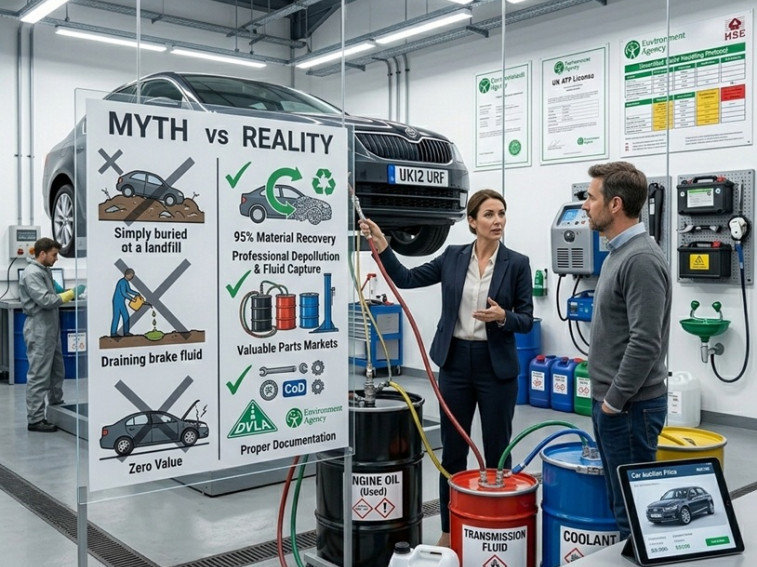
This is perhaps the most widespread and outdated myth concerning vehicle disposal. The truth is that Authorised Treatment Facilities (ATFs) are legally bound to meet stringent recovery targets. Authorised Treatment Facility standards require these facilities to recover and reuse at least 95% of the vehicle's weight. This recovery rate includes everything from plastics and glass to high-value steel and aluminium. Meeting ELV recovery targets ensures maximum material reuse.
Hardly any part of a modern ELV goes to waste when handled correctly. The entire process is designed to return valuable commodities to the manufacturing supply chain. Metals are melted down for reuse, while intact components often find a second life on the second-hand market.
You Need to Drain All Fluids Yourself
Another common misconception is that the owner must perform hazardous preparatory work, such as draining oil, fuel, and coolant. Thankfully, this isn't necessary and is strongly discouraged for safety reasons. Licensed ATFs are equipped with specialist tools and containment systems designed for the safe depollution of vehicles.
Part of the legal recycling process involves carefully removing all hazardous materials and fluids, including brake fluid and air conditioning gas. They also remove mercury switches and explosive airbag components in a controlled environment. When professional service is used, customers are relying on the facility's expertise to handle dangerous substances properly.
Maximising Value and Avoiding Common Pitfalls
For many owners, the primary concern when considering scrapping is whether the process is financially worthwhile or legally safe. While a very old or severely damaged car may only yield scrap metal value, other ELVs can hold significant residual worth, especially for reusable components. Professional guidance is essential to help find the point where selling as salvage is better than scrapping. Sometimes, even vehicles requiring extensive work, like some commercial van auctions stock, can be more profitable through auction than immediate scrap.
Scrapping Isn't Worth the Effort
This myth often arises when owners receive a low initial quote for a truly dilapidated car. While a full write-off might fetch a modest return, many vehicles considered "scrap" by their owners still retain significant value. This value is tied directly to the quality and availability of their parts.
Dismantlers pay based on weight and market demand for reusable components, such as engines, gearboxes, and body panels. This is why using an experienced service is crucial; they can assess the total potential value accurately. If a later model vehicle has low-impact damage, it could even qualify for salvage auctions, potentially netting a much higher return than a pure scrap price.
You Can Scrap a Car Without the V5C Logbook
This is a legal pitfall that all owners must strictly avoid. The V5C logbook (Registration Certificate) is the primary proof of ownership and is legally required when disposing of a vehicle. Understanding V5C logbook requirements is crucial, as some unscrupulous operators might claim to accept a vehicle without it, leaving the previous keeper legally exposed.
Without the V5C, owners cannot correctly notify the DVLA that the vehicle has been transferred, meaning they could remain liable for any road tax, insurance requirements, or fines associated with the car. An ATF will need the V5C to issue the mandatory Certificate of Destruction (CoD) and finalise the transaction with the DVLA on the owner's behalf. Always ensure the yellow slip from the V5C and the CoD are received for personal records. Always ensure the yellow slip from the V5C and the CoD are received for personal records. This commitment to proper paperwork and documentation is part of what makes RAW2K Vehicle Auctions a trusted partner for vehicle disposal and salvage acquisition.
The Environmental and Legal Realities of Responsible Recycling
Choosing a compliant recycling route is not just a matter of convenience; it is a legal and environmental responsibility. Adherence to regulations protects users from potential fines and ensures toxic materials are handled safely. Transparency and legality are paramount when dealing with end-of-life vehicles.
Any Local Garage Can Legally Scrap Your Vehicle
The UK government regulates which facilities can accept and process ELVs. Only those granted ATF status are legally permitted to issue a Certificate of Destruction. These facilities are audited to ensure they follow Authorised Treatment Facility standards for depollution and recycling rigorously. If a facility isn't ATF-licensed, it cannot lawfully scrap the car, meaning hazardous waste and administrative duties are likely being handled incorrectly. This applies equally to cars, vans, and motorcycles requiring disposal.
If a Certificate of Destruction is not received, the DVLA considers the previous owner the legal keeper of the vehicle, which can result in ongoing road tax demands or penalties. Always verify that the chosen company operates under the required environmental and waste permits before handing over a vehicle. This diligence is especially important when dealing with vehicles located far afield, such as those subject to vehicle auctions in Scotland.
Scrap Vehicles Don't Feed the Spares Market
This belief fundamentally misunderstands the circular economy of vehicle maintenance and repair. In reality, dismantled ELVs are the lifeblood of the second-hand parts market, providing affordable and authentic components for mechanics and private repairers across the country. Scrapped vehicle components serve as the vital supply chain for a mechanic's workshop.
Components like headlights, doors, engine control units, and even entire axle assemblies are tested, catalogued, and resold. This extends the life of countless other vehicles, reducing the need for expensive new components and making repairs more cost-effective. Professional repairers often source these tested components from specialist markets. The value retained by these working parts is a significant factor in the price paid by the recycling facility.
Beyond the Myth: Understanding Vehicle Liquidation
The line between a salvage vehicle ready for repair and a true scrap vehicle is often blurred. An experienced dealer understands that a car an owner considers scrap might be a profitable salvage purchase. For example, a dealer sourcing an engine in the North East UK might identify a flood-damaged, non-running car in an auction, which an owner would scrap. If inspection reveals the engine block is intact, the dealer can acquire the vehicle cheaply, saving significantly compared to buying a new crate engine. This expertise allows dealers to secure parts efficiently.
It is vital to explore all options before scrapping. If a vehicle is too damaged for auction or resale, professional Scrap Car Recycling Facts vs Myths services ensure the proper legal paperwork and the highest possible recovery value are received. If the damage is less severe, or the vehicle is a desirable commercial model, listing it with reputable auctioneers can often yield a better financial outcome.
To gain full confidence in the decision, buyers should check out RAW2K's current auction listings to compare prices for similar vehicles. This insight gives a real-time market appraisal of what a vehicle, or its components, might be worth.
Finding the Right Way Forward
By moving past the common Myths About Scrap Car Recycling, owners can approach their ELV decision with clarity and confidence. The process is governed by strict compliance laws, ensures high ELV recovery targets, and can still offer real financial value. The responsibility lies in choosing an ATF-licensed operator for scrapping or a trusted auction platform for salvage. For expert guidance on selling a salvageable vehicle, or for advice on auction registration, contact us for support. RAW2K Vehicle Auctions supports both private individuals and professional dismantlers through every stage of the vehicle lifecycle.