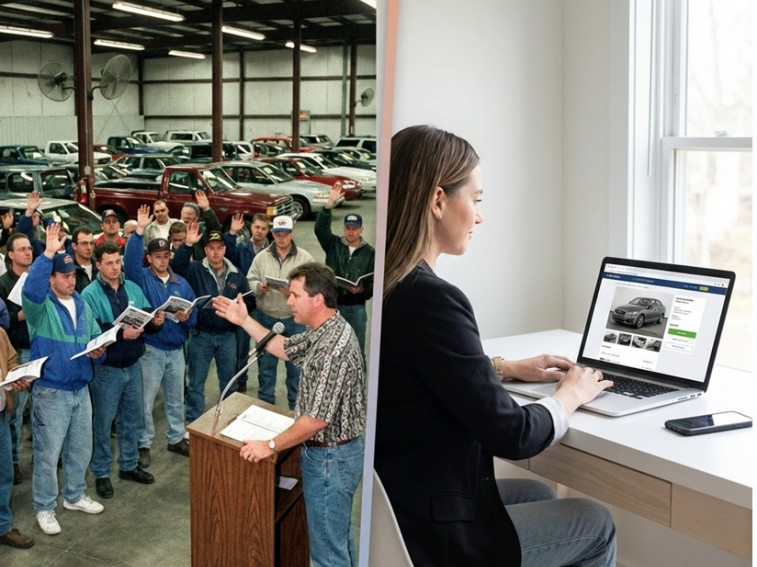
Cast your mind back, if you can, about three decades. Imagine needing a car or van for your business. What did 'going to auction' mean then? For many, it conjures images of chilly mornings, crowded halls buzzing with a unique tension, a fast-talking auctioneer whose words sometimes blurred into one, and perhaps a slightly greasy bacon butty from a nearby van. It was an experience, alright! But compare that to today, where you can browse, bid on, and buy vehicles from across the country, all from your office desk or even your phone whilst grabbing a coffee. The auction changes over 30 years have been nothing short of revolutionary, particularly within the UK's automotive sector.
This isn't just about swapping a physical gavel for a digital click; the entire landscape has transformed. The car auction evolution reflects broader technological shifts, changing business needs, and a demand for greater transparency and convenience. For businesses, especially start-ups and SMEs needing reliable vehicles without the brand-new price tag, understanding this evolution is key to leveraging the fantastic opportunities modern auctions, like those hosted right here at Raw2k, present. Let's take a stroll down memory lane and see just how far we've come.
The Good Old Days? Auctions Circa Early 1990s
Picture the scene: a large, often somewhat industrial-looking building. Rain might be lashing against the windows (this is the UK, after all). Inside, vehicles are lined up, perhaps driven through one by one. Potential buyers, mostly seasoned dealers and a few brave private individuals or small business owners, jostle for position, craning their necks for a better view.
What Was It Really Like?
Physical Presence Was Mandatory: There was no other way. You had to be there. This meant carving out significant time – travel, waiting, bidding, arranging collection. For a business owner juggling a million tasks, a whole day (or more!) spent at an auction was a major commitment. Geographic location was also a huge barrier; you were generally limited to auctions within reasonable driving distance. Forget easily sourcing a specific van model located in Scotland if you were based in the South East.
Information Was Scarce: You'd likely get a printed catalogue, maybe put together the day before, with brief descriptions. Lot numbers, make, model, year, perhaps mileage. Condition? That was largely down to your own eyes and a quick poke around before the bidding started (if allowed). There was a definite information asymmetry – experienced dealers often knew what to look for, the hidden signs of trouble, giving them an edge. It was very much 'buyer beware'.
The Bidding Frenzy: The heart of the auction was, and still is, the bidding. But back then, it was purely a physical, vocal affair. The auctioneer, a figure of rapid-fire patter and sharp observation, controlled the room. Bids were shouted, signalled with nods, winks, or raised hands. It could be intimidating for newcomers and required quick thinking and confidence.
Payment and Logistics: Settling up often meant cash, a banker's draft, or perhaps a cheque (remember those?). Then came the logistics of actually getting your newly acquired vehicle off the premises, often involving arranging recovery trucks or temporary insurance on the spot.
The Challenges for Businesses
For a growing business needing vehicles, this traditional model presented hurdles:
-
Time Sink: As mentioned, the time commitment was substantial.
-
Geographic Lottery: The best deals or the specific vehicles you needed might be hundreds of miles away, effectively inaccessible.
-
Risk Factor: Limited information meant a higher risk of buying a vehicle with hidden problems.
-
Competitive Disadvantage: Competing against seasoned traders on their home turf could be tough.
It sounds almost quaint now, doesn't it? But this was the reality for decades. It worked, but it wasn't always efficient or accessible, especially for smaller enterprises.
Whispers of Change: The Dawn of the Digital Age (Mid-90s to Early 2000s)
The seeds of the car auction evolution were sown with the arrival of the internet in homes and businesses. It wasn't an overnight revolution, more like a slow sunrise.
Early Digital Footprints
Initially, the internet's impact was minimal. Auction houses might have launched basic websites – think digital brochures listing upcoming auction dates and locations. Maybe, just maybe, you could download a PDF version of that printed catalogue. It saved a phone call, perhaps, but didn't fundamentally change the need to be physically present to inspect and bid.
Technology like fax machines allowed for slightly quicker document transfer, and pagers (later, basic mobile phones) meant buyers could be reached more easily. Some forward-thinking auctions might have started experimenting with digital photography, providing a few grainy images online. Quality was often poor, connections were slow (dial-up, anyone?), and trust in purely digital representations of physical assets like cars was low.
The Stirrings of Accessibility
Whilst you still generally had to attend in person, these early digital steps began to chip away at the information barrier. You could at least see what was coming up further afield, even if attending wasn't practical. It planted the idea that perhaps geography didn't have to be the ultimate limiting factor. The trade started to see the potential, even if widespread adoption was still years away. This period was less about transformation and more about augmentation – digital tools supporting the existing physical process.
Going Hybrid: Online Bidding Enters the Arena (Mid-2000s to 2010s)
This is where the auction changes over 30 years really started to gather pace. Widespread broadband adoption was the game-changer. Suddenly, transferring larger amounts of data, including better quality images and even basic video, became feasible.
The Rise of the Online Platform
Auction houses began developing rudimentary online bidding platforms. This led to the hybrid auction model: a live, physical auction happening in the traditional hall, but simultaneously streamed online. Registered online bidders could watch a video feed, hear the auctioneer, and click a button to place their bids in real-time, competing directly against the people physically in the room. This simulcast bidding technology revolutionised accessibility for buyers unable to attend in person. The development of simulcast bidding technology represented a major breakthrough in democratising auction access.
Benefits Begin to Stack Up
Breaking Down Borders: This was huge. A business owner in the West Midlands could now realistically bid on a fleet of vans located at an auction in the North East. The pool of potential buyers expanded dramatically for sellers, and buyers gained access to a much wider selection of stock. Raw2k's vehicle auctions today embody this nationwide reach, connecting buyers and sellers across all regions, including Wales and Northern Ireland.
Improved Information: Online listings started becoming more detailed. Multiple photographs from various angles became standard. Basic condition reports, noting obvious damage or mechanical issues, began to appear. Whilst still not perfect, it was a significant step up from just a line in a catalogue.
Convenience (Sort Of): You still needed to be logged in at the specific time the auction was running, but at least you could do it from your office. No travel time, no cold halls.
Lingering Hurdles
Trust was still a major factor. Could you really rely on photos and a brief report to make a significant purchase? What if the colour wasn't quite right, or the report missed something? Internet connections could be unstable, potentially causing you to miss out on a crucial bid. Many still preferred the 'tyre-kicking' certainty of a physical inspection. The technology itself could also be clunky, requiring specific software or browser plugins. The hybrid auction model represented progress, but wasn't yet perfected.
The Full Digital Shift: Online-Only Auctions Take Centre Stage (2010s to Present)
The last decade or so has seen the final major phase of the car auction evolution: the widespread adoption and refinement of online-only auctions. This is the model platforms like Raw2k excel at, moving the entire process online.
Why Online-Only Gained Dominance
Several factors converged:
Ubiquitous Internet & Mobile Tech: High-speed internet is now the norm, and smartphones mean people can access information and bid from anywhere, anytime. Dedicated auction apps provide a seamless experience.
Enhanced Transparency & Detail: This was crucial for building trust. Online listings evolved to include:
-
High-Resolution Imagery: Dozens of photos covering every angle, inside and out, including close-ups of any damage.
-
Video Walkarounds: Allowing potential buyers to get a better feel for the vehicle.
-
Detailed Condition Reports: Often standardised, conducted by independent inspectors, covering mechanical checks, bodywork, interiors, and documentation. Vehicle history checks (HPI) became integrated.
-
Comprehensive Descriptions: Engine specs, features, service history details, V5 information.
Sophisticated Bidding Platforms: The timed auction format became popular alongside live online bidding. Features like the proxy bidding system (where you set your maximum bid, and the system bids incrementally for you) added convenience and strategy. The proxy bidding system allowed buyers to set limits and let technology handle the competitive bidding automatically. Secure online payment systems streamlined the transaction process. The timed auction format gave buyers flexibility to bid at their convenience over extended periods.
Data Accessibility: Buyers could more easily research market values for similar vehicles, empowering them to bid more confidently.
External Factors: Events like the COVID-19 pandemic massively accelerated the shift to digital across all industries. Physical auctions were impossible during lockdowns, forcing even the most reluctant businesses to embrace online alternatives. Many discovered the convenience and efficiency and never looked back.
Specialisation and Niche Markets
The online model also facilitated greater specialisation. Platforms could easily categorise and host auctions specifically for certain vehicle types. Need a motorbike? There are dedicated motorcycle auctions. Looking for commercial vehicles? Check out specialised van auctions. This makes it much easier for buyers to find exactly what they need without wading through hundreds of irrelevant listings.
The pace of auction changes over 30 years truly hit hyperspeed in this last decade, transforming it from a niche, sometimes intimidating process into a mainstream, accessible, and highly efficient way to source vehicles for businesses of all sizes across the UK.
The Raw2k Experience: Modern Auctions Made Easy
Platforms like Raw2k represent the culmination of this 30-year evolution. We've taken the best aspects of the auction process – the potential for great value, the wide variety of stock – and combined them with the power and convenience of modern technology.
What Does Buying Through Raw2k Look Like Today?
Imagine you're Sarah, owner of a growing catering business in the North West. You need a reliable used van, quickly and without breaking the bank. Thirty years ago, this might have meant days spent trawling local dealers or travelling to a physical auction.
Today, Sarah grabs her tablet during a lunch break. She logs onto Raw2k.
Easy Browse: She filters listings specifically for vans through our van auctions, maybe by make, model, or mileage.
Detailed Information: She finds a promising candidate. She can view dozens of high-quality photos, watch a video walkaround, and read a detailed condition report noting minor scratches and confirming its service history. The V5 is present, and the MOT is valid for 8 months.
Informed Bidding: She checks recent sale prices for similar models using online resources, then decides on her maximum bid. She enters this as a proxy bid on the Raw2k platform using our proxy bidding system.
Winning the Auction: A few days later, the timed auction ends. Sarah receives an email – she won the van at a price well within her budget!
Simple Completion: Payment is made securely online. Raw2k provides clear instructions for collection, or options for delivery coordination.
The entire process, from finding the van to securing it, took maybe an hour of her active time, spread over a few days, fitted around her busy schedule. No travel, no crowded halls, just efficient, transparent vehicle sourcing. This is the power of the modern car auction evolution.
Benefits for Your Business
-
Unmatched Convenience: Browse and bid 24/7 from anywhere.
-
Vast Selection: Access vehicles from across the UK through comprehensive vehicle auctions, not just your local area. Find exactly what you need, whether it's a standard car, a specialised van, or even a motorcycle.
-
Transparency: Detailed listings, condition reports, and photos minimise surprises.
-
Efficiency: Save valuable time compared to traditional methods.
-
Competitive Pricing: The auction format still drives competitive prices, offering the potential for significant savings.
Some Things Never Change: The Enduring Appeal
Despite all the technological advancements and the auction changes over 30 years, the core appeal remains remarkably consistent.
The Thrill of the Chase: There's still excitement in finding that perfect vehicle and placing the winning bid.
The Hunt for Value: Auctions continue to be a prime source for securing vehicles below typical retail prices. This is especially vital for businesses managing tight budgets.
Efficient Disposal and Acquisition: For both buyers and sellers (Raw2k primarily sources vehicles from insurance companies, trade sources, etc., offering them to you), auctions provide an efficient mechanism to transact vehicles quickly.
Technology hasn't replaced the fundamental purpose of the auction; it has enhanced it, making it more accessible, transparent, and efficient for everyone involved.
Peeking into the Future
The car auction evolution isn't finished yet. What might the next few years bring?
AI Integration: Artificial intelligence could play a role in even more detailed and objective condition reporting or analysing market trends.
Virtual Reality (VR): Could VR tours offer an even more immersive 'inspection' experience from afar?
Enhanced Data: Even greater integration of vehicle history, running costs, and predictive maintenance data might become standard.
Sustainability Focus: More information and potentially dedicated auctions focusing on electric and hybrid vehicles.
Whatever the future holds, the focus will undoubtedly remain on increasing trust, convenience, and value for buyers and sellers.
Thirty Years On: Auctions Transformed
From the drafty halls and paper catalogues of the early 90s to the sophisticated online platforms like Raw2k today, the journey has been incredible. The auction changes over 30 years have democratised access, empowered buyers with information, and streamlined the entire process.
For UK businesses, this car auction evolution means sourcing the vehicles you need – cars, vans, motorbikes – is easier, faster, and often more cost-effective than ever before. You gain access to a national marketplace from your desk, backed by detailed information and secure systems.
Ready to experience the benefits of modern vehicle auctions for your business?
Explore the wide range of vehicles currently available in our online auctions.
Ready to start bidding? Register for free access to all our vehicle listings.
Got questions? Don't hesitate to get in touch with our friendly team.
Welcome to the future of vehicle auctions – it's efficient, transparent, and waiting for your bid!